How Sour Candy Works: Acids, Coatings and Why the Sourness Fades
The food science of sour candy: citric, malic and tartaric acid compared, sanding versus spraying, why sourness fades as you chew, and why some sours burn.
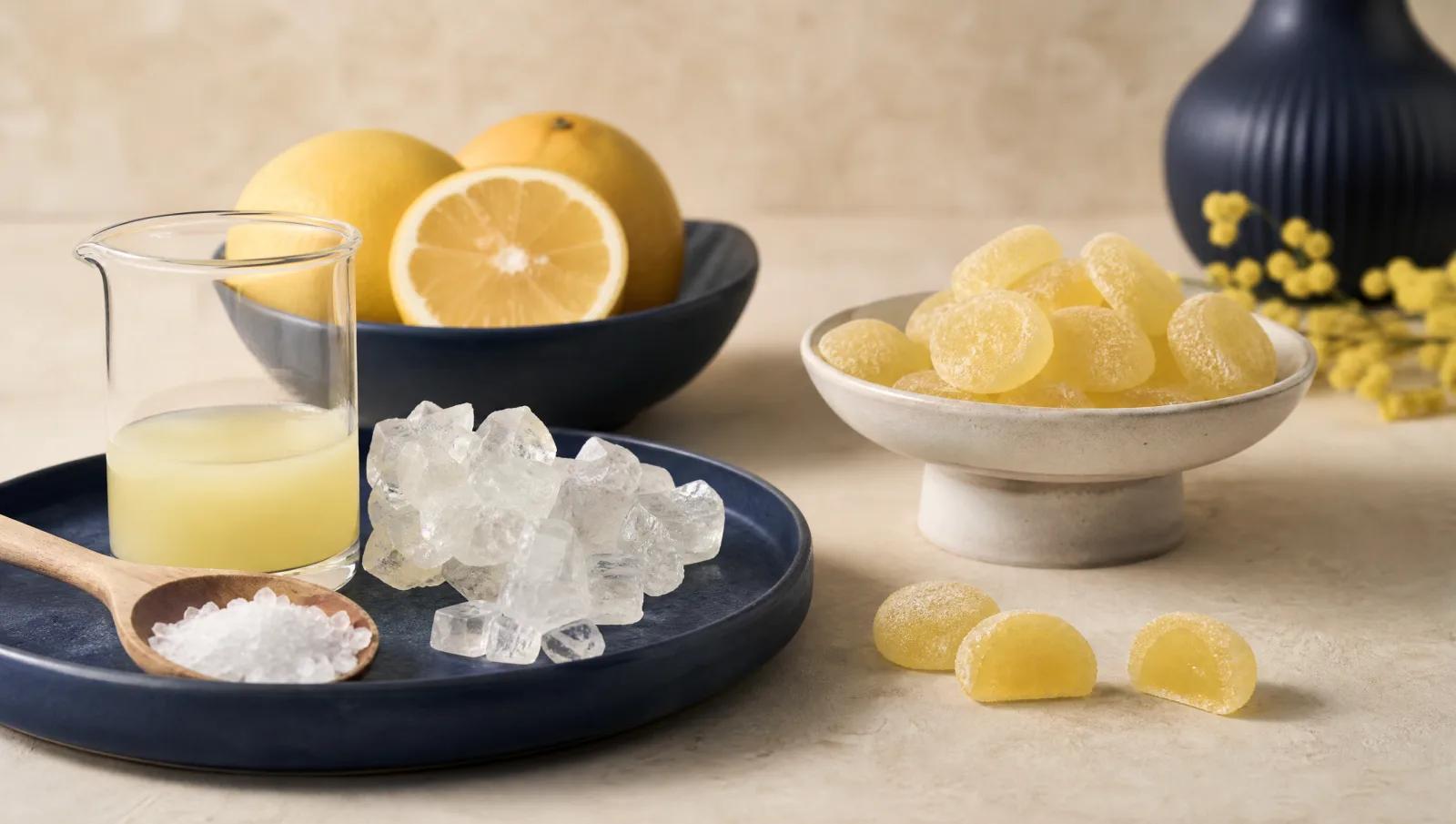
Sour candy works by putting an acid where your tongue meets it first. Citric, malic and tartaric acid trigger the same sour receptors at different speeds, and most of the acid sits in a sanded or sprayed coating rather than in the piece itself. That coating dissolves in seconds, which is why the sourness fades before the sweetness does. We import sour candy by the case and we have opened a lot of bins that went wrong, so this page is the reference we send people when they ask why one sour is sharp and gone while another sits on the tongue. It is also the piece the rest of our sour cluster links back to.
What "sour" actually is
Sour is the only one of the basic tastes with a single, simple trigger. Sweet needs a sugar shaped a particular way. Bitter has dozens of receptors. Sour is protons. When an acid dissolves in saliva and protons enter the sour-sensing taste cells on the tongue, those cells fire, and your brain reads it as sour.
That has two consequences that matter for candy.
The first is that pH on its own does not tell you how sour something tastes. What matters more is titratable acidity, meaning how much acid is actually there to keep supplying protons as saliva dilutes it. Two candies can sit at the same pH and taste noticeably different, because one runs out and the other does not.
The second is that weak organic acids taste more sour than a strong mineral acid would at the same pH. Undissociated acid molecules can cross into the taste cell and release their protons on the inside, which is a more direct route than protons floating around in the mouth. This is why confectionery uses food acids like citric and malic rather than anything harsher, and it is not only a safety choice. They genuinely work better.
The acids that do the work
Almost every sour candy in our warehouse is built on one or two of these, usually blended.
Acid: Naturally found in: Onset: How long it lasts: Working notes
Citric: Citrus fruit: Fast, bright: Short: The default. Cheap, very soluble, blends well with fruit flavours. Picks up moisture readily
Malic: Apples, stone fruit: Slightly slower: Longer, rounder: Higher perceived intensity per gram over time. The backbone of most extreme sours
Tartaric: Grapes: Fastest, hardest: Short: A sharp punch with a slightly astringent edge. Common in European sweets
Fumaric: Fumitory: Slow: Longest: Barely soluble, so it releases gradually. Low moisture pickup makes it useful in coatings
Lactic: Fermentation: Soft: Medium: Mild and slightly creamy. Usually a supporting acid, rarely the lead
Two practical points fall out of that table.
Fumaric acid is the quiet workhorse. It is the least hygroscopic of the common food acids, meaning it pulls the least water out of the air, so a coating built partly on fumaric survives a humid bin better than one built purely on citric. If you have ever wondered why one brand's sour coating still sparkles in August and another has gone dull, this is usually the reason.
And blends beat single acids. Citric gives the immediate hit, malic carries the middle, fumaric drags out the tail. A candy formulated with all three tastes sour for longer than one built on citric alone at the same total acid load.
Where the acid goes: on the piece or in it
This is the part most people get wrong. In a sour gummy, the great majority of the acid you taste is on the outside, not inside.
Method: How it is done: What it feels like: The trade-off
Sanding: Pieces are tumbled in a dry sugar and acid blend that sticks to a slightly tacky surface: Crunchy, gritty, front-loaded: Crystals rub off in transit and pool at the bottom of the bin
Fine dusting: A very fine acid and sugar powder, sometimes with an anti-caking agent: Intense and powdery, coats the tongue: The dustiest option in a bulk bin, and the most moisture-sensitive
Spray then dust: A light solution or oil is applied first so the powder adheres evenly: Even and consistent piece to piece: Needs a drying step, and gives less crunch
Acid in the mass: Acid is mixed into the gummy or the boiled sugar before depositing: Mild, slow, steady, no grit: Limited by chemistry. Too much acid weakens a gelatin or pectin set
Fizz: Sodium bicarbonate sits alongside the acid and reacts with saliva: A prickle rather than pure sourness: Reacts with any moisture, so the packaging has to hold
The reason coatings dominate is structural. Acid does not just taste sour in a gummy, it interferes with the setting. Drop the pH of a gelatin or pectin system too far and the gel sets weakly, sets slowly, or breaks down over the shelf life. So the amount of acid you can bury inside a soft piece has a hard ceiling, and the only way past it is to put the rest on the outside where it cannot touch the gel. Boiled hard candy has no such ceiling, which is a different construction problem we cover in sour hard candy.
Why the sourness fades as you chew
Three things happen at once, and all three run in the same direction.
The coating is gone in seconds. A sanded or dusted surface dissolves in saliva almost immediately. Call it five to fifteen seconds depending on how much you chew. After that you are tasting the interior, which carries a fraction of the acid.
Your saliva fights back. Acid in the mouth triggers a jump in saliva flow, and saliva carries bicarbonate, which is a buffer. So the mouth simultaneously dilutes the acid and neutralises it. The harder the sour hits, the faster this response ramps up.
The receptors adapt. Continuous stimulation dulls the response, the same way a smell fades after a minute in a room. Sour adapts quickly.
Meanwhile the sugar in the piece keeps releasing steadily as you chew through it, because it is distributed all the way through rather than painted on. So the sweet outlasts the sour every time. That asymmetry is the whole reason a very sour candy tastes like a plain fruit gummy by the fourth chew, and it is why "how sour is it" is a much less useful question than "how long does the sour last."
Why some sours burn
The burn is not taste. It is chemical irritation of the soft tissue in the mouth, and it comes from concentrated acid sitting against the tongue and the inside of the cheek for longer than the tissue can buffer.
A few things make it worse: a very fine powder that spreads and clings rather than dissolving and being swallowed, eating several pieces back to back so the mouth never recovers, and holding a piece against one spot instead of moving it. People who eat a lot of extreme sour candy in one sitting sometimes end up with a raw or tender tongue for a day or so.
There is a second effect worth stating plainly and without drama: food acids soften tooth enamel, and that is true whether or not the candy contains sugar. We are candy importers, not dentists or doctors, and nothing here is medical advice. If sour candy hurts your mouth, the sensible response is to stop eating it, and any question about your teeth belongs with your dentist.
Sweet and sour are not independent
The last piece of the mechanism is that sugar and acid suppress each other on the tongue. More acid makes a piece taste less sweet, more sugar makes it taste less sour, and the good sour candies are the ones where a formulator found a ratio that lets both survive. We took that apart separately in sweet and sour candy, because it is the difference between a sour people finish and a sour people dare each other to try once.
What all of this means for storage
If the sourness lives in a coating, and the coating is made of hygroscopic acid and sugar, then humidity is the enemy of your product.
Above roughly 55 to 60 percent relative humidity, a sanded sour coating starts pulling water out of the air. First it loses the matte sparkle and goes glassy. Then it goes tacky. Then the pieces weld to each other and the sourness is measurably weaker, because the acid has partially dissolved into a syrup on the surface and redistributed. Nothing about this is reversible.
Keep bags sealed until you fill, keep lids down, fill bins shallower and refill more often, and rotate first in first out. The wider version of that argument is in Swedish candy shelf life, and the bin-level version is in sour candy for retailers.
One of each construction
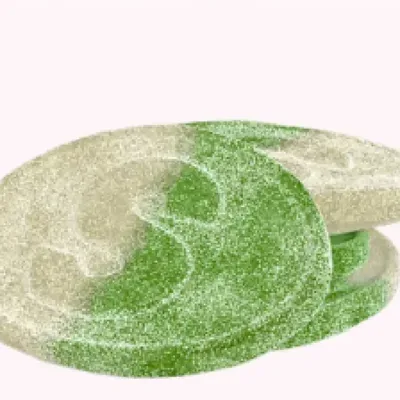
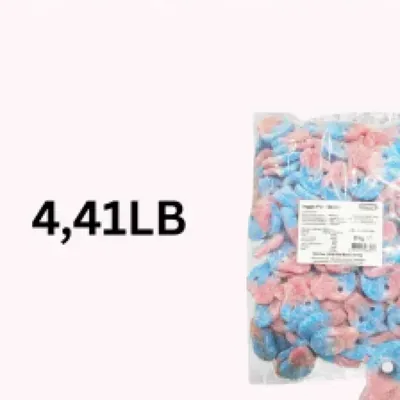
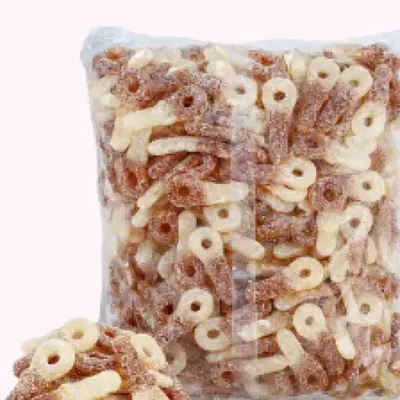
Those four are a sanded sour disc, a fizzing skull, a sanded soft pacifier and an XL sour gummy, which is roughly the span of constructions you can build a sour section from. Note the dietary flags before you label anything: Matthijs is flagged gluten-free, halal, vegan and vegetarian, while the S-Märke and Sura lines are flagged halal and vegan but do contain wheat, so neither is a gluten-free item. The Vidal case carries no flags in our data, so we publish none.
Frequently asked questions
What makes sour candy sour?+
A food acid, usually citric, malic or tartaric, and usually applied as a sanded or sprayed coating on the outside of the piece. When the acid dissolves in saliva, protons enter the sour-sensing taste cells on your tongue and those cells fire. No acid, no sour.
Which acid is the most sour?+
Per gram, malic and tartaric hit harder than citric, and fumaric lasts longest because it dissolves slowly. Most manufacturers blend them: citric for the immediate hit, malic for the middle, a slower acid for the tail. A blend tastes sour for longer than any single acid at the same total load.
Why does sour candy stop being sour after a few seconds?+
Because the acid is mostly on the surface. The coating dissolves within seconds, your saliva flow increases and buffers what is left, and the taste receptors adapt. The sugar inside keeps releasing the whole time, so the sweetness outlives the sourness.
Why does sour candy burn my tongue?+
That is chemical irritation from concentrated acid held against the tissue, not a taste. Fine powders, several pieces in a row and holding a piece in one spot all make it worse. We are not medical professionals, so treat this as description rather than advice, and stop eating it if it hurts.
Is sour candy worse for your teeth than regular candy?+
Food acids soften enamel regardless of the sugar content, which is why sugar-free sour candy is not automatically a kinder option. That is as far as we will go. Ask a dentist for anything that applies to you.
Why did my sour candy lose its sour coating in storage?+
Humidity. Acid and sugar coatings pull water out of the air above roughly 55 to 60 percent relative humidity, dissolve into a syrup on the surface, and the piece goes tacky and dull. Keep it sealed, keep bin fills shallow, and rotate stock.

Gustav Lindqvist · Candy Master
Gustav grew up in Sweden on a strict Saturday-candy schedule, mixing his lördagsgodis bag at the lösgodis wall before he could spell salmiak. He has spent years tasting his way across Scandinavian candy, and now curates the range at TheSweetsTruck, from BUBS sour skulls to the saltiest licorice most people cannot finish.
Last updated 8/23/2026