Blue Swedish Fish: Blue Raspberry, and Why Colour Works Differently in Sweden
Blue fish are blue raspberry, a US flavour convention with no fruit behind it. Where blue raspberry came from, and how colour actually maps to flavour in genuine Swedish candy.

Blue fish are blue raspberry, an American flavour convention rather than a fruit. Blue exists in US candy because red was crowded, not because anything blue tastes like that. In genuine Swedish fish candy, colour is a much looser signal, and blue usually arrives through sour lines.
Blue raspberry is a US invention
There is no raspberry that tastes like blue raspberry. The flavour is a candy construct, and it exists for a practical reason.
Mid-century American confectioners and ice pop makers had a colour problem. Cherry, strawberry, watermelon and raspberry were all red. On a shelf of freezer pops or a tray of gummies, a customer could not tell them apart. Raspberry was the one that got moved, and blue was the colour available: FD&C Blue No. 1 was a certified, stable, cheap food colour that held up well in sugar systems.
The story usually told adds a botanical excuse. The whitebark raspberry, Rubus leucodermis, does produce a dark blue-black fruit, which gave the naming just enough cover to stick. Whether that actually drove the decision or was reverse-engineered afterwards is hard to establish. Either way, the flavour compound itself is a sweet, slightly floral berry blend that leans on the same ester family as raspberry, pushed further towards candy than towards fruit.
Two things follow. First, blue raspberry is largely a North American convention. Ask for it in a Swedish sweet shop and you will get a blank look, or a sour product that was itself built for export. Second, in a US gummy assortment a blue piece almost always signals blue raspberry or a generic "berry", which is why American shoppers reach for the blue one expecting a specific taste.
The trademark note
"Swedish Fish" is a registered US trademark of Mondelez International. We do not sell that product and are not affiliated with it. The blue piece people search for is theirs. What we import is the Swedish fish-shaped candy the American product was modelled on, plus the Swedish blue lines that genuinely exist. Why they are called Swedish Fish covers how the name travelled.
How colour works in Swedish candy instead
Swedish candy does not run a strict colour-to-flavour code. Colour is used as a visual cue for the bag as a whole, and the flavour differences inside a single assortment can be subtle enough that most people cannot reliably name them blind.
Here is roughly how the mapping tends to run:
Colour: What it usually signals in Swedish candy
Pastel pink, mint, lemon: a soft mixed-fruit assortment, differences deliberately gentle
Deep red: jordgubb (strawberry) or hallon (raspberry)
Green: apple, usually sour, sometimes pear
Yellow: lemon or pineapple
Blue: blue raspberry in sour lines, or bubblegum. Blabar (bilberry) is far rarer in candy than outsiders assume
Black or dark brown: lakrits or salmiak, never fruit
White or cream: usually a skum (foam) texture rather than a flavour
The pastellfiskar format is the clearest illustration. The pieces come in soft pastel shades, but the point of the colour is the look of the mixed bag, not a flavour promise. There is more on that in pastellfiskar and pastel fish, and the broader picture in Swedish candy flavors.
The blue we actually carry
Blue does exist in our catalogue, and it comes from where you would expect: sour lines and licorice-format slices.
S-Märke sour blue raspberry comes in an 8.81 lb case and is labelled halal and vegan. It is a Swedish sour line built for the blue raspberry palate, and it is the closest genuine Swedish product to what a US shopper means by "blue". More on the brand in S-Märke.
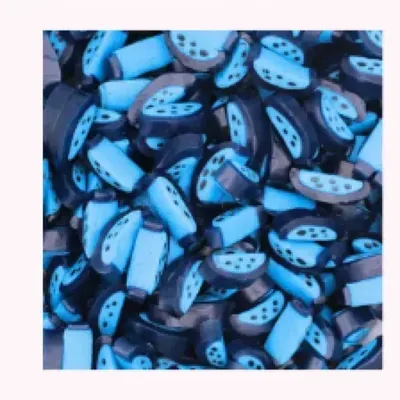
Blue Raspberry Licorice Slices, a 6.6 lb case, are the other blue on the wall. Licorice slices here means the format (a soft layered slice), not salty licorice flavour, which trips up American buyers regularly. They give you a blue piece with a completely different shape and mouthfeel, which is useful when your wall already has plenty of gummies.
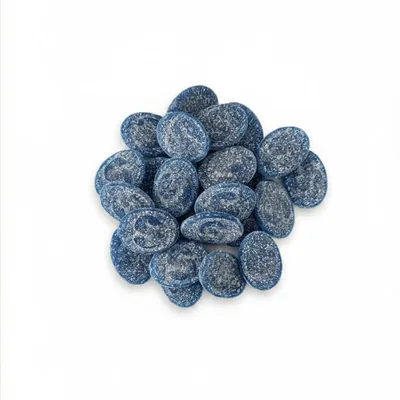
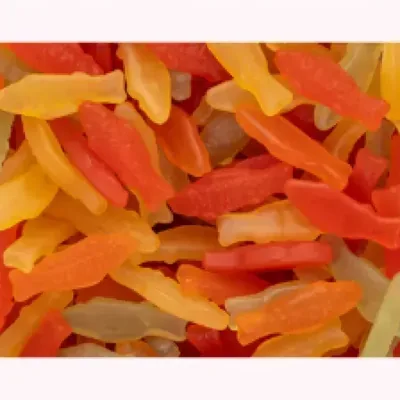
Bubs Forest Berries ovals, in 90g bags by the dozen, cover the darker berry end without pretending to be blue raspberry. And Pastel Fish is the reference point for what fish candy looks like when nobody is colour-coding anything.
Where blue actually comes from in our range
Merchandising blue
A practical note. Blue is the strongest visual break you can put in a candy wall, because almost nothing else in the category is blue. One blue bin in a run of reds, pinks and yellows does more for the look of a wall than two more fruit flavours would.
It also skews young. If your traffic is families and teenagers, blue earns its bin. If your traffic is adults buying Nordic candy as a gift or a nostalgia purchase, blue is the least important thing on your list and the pastel and licorice formats will outsell it.
Ordering
Cases ship from Santa Fe Springs, California, by UPS Ground or UPS Express, normally 2 business days domestically. Canada ships DDP with duties paid at checkout, typically 3 to 5 days. Orders of $2,000 or more can move on a pallet, arranged by email. Order by the case, mix and match, no order minimum. Tier 1 wholesale pricing is public.
Frequently asked questions
What flavour is the blue Swedish fish?+
Blue raspberry, in American assortments. It is a candy flavour rather than a real fruit: a sweet, slightly floral berry blend created so that raspberry could be told apart from the other red flavours. Genuine Swedish fish candy does not traditionally include a blue raspberry piece.
Is blue raspberry a real fruit?+
No. Some raspberry species produce dark blue-black fruit, including the whitebark raspberry, and that is often cited as the naming excuse. But the flavour sold as blue raspberry is a formulated candy blend, not an extract of any blue fruit, and it does not taste like fresh raspberry either.
Why is blue candy so common in the US and not in Sweden?+
Because the problem it solved was American. US freezer pops and gummy assortments needed to separate several red flavours visually, and blue was the available certified colour. Swedish assortments were built around a different set of flavours, licorice and foam textures among them, and never needed the same fix.
Do you sell blue Swedish Fish?+
Not the trademarked American product. We import Swedish blue lines instead: S-Märke sour blue raspberry in an 8.81 lb case, labelled halal and vegan, and Blue Raspberry Licorice Slices in a 6.6 lb case. Both are genuine European product, sold by the case to US and Canadian buyers.
Is the blue colouring in Swedish candy the same as in American candy?+
Not necessarily. EU and US colour approvals differ, and European makers frequently reach for plant-based colours where an American maker would use a certified synthetic. If a specific colourant matters to your customers or your state's labelling rules, check the case label rather than assuming.
Does blue raspberry candy taste different in European versions?+
Often, yes, and it is a matter of taste which you prefer. European blue raspberry tends to be less sweet and a little more tart, since it usually appears in sour lines rather than as a standalone sweet flavour. Some American customers find it thinner, others find it cleaner.

Gustav Lindqvist · Candy Master
Gustav grew up in Sweden on a strict Saturday-candy schedule, mixing his lördagsgodis bag at the lösgodis wall before he could spell salmiak. He has spent years tasting his way across Scandinavian candy, and now curates the range at TheSweetsTruck, from BUBS sour skulls to the saltiest licorice most people cannot finish.
Last updated 8/23/2026