Danish vs Swedish Candy: The Real Differences
Danish vs Swedish candy compared on licorice intensity, foam (skum), shapes, and pick-and-mix culture, from an importer who sold both in Sweden.

Danish candy is licorice-led: lakrids, salty licorice, and wine gums from a bland selv wall. Swedish candy is sour-and-foam-led: sour gummies, skum pieces, and a huge shape range from a lösgodis wall. Both buy loose by weight. Denmark goes darker and saltier, Sweden goes tarter and softer.
We ran candy shops in Sweden before we started importing to the US, which meant serving plenty of Danish customers who told us exactly what our wall was missing. The two countries are close enough that outsiders lump them together and different enough that locals find that funny. Here is the honest head-to-head. For the four-country view, see our Nordic candy comparison and the Scandinavian candy guide.
Licorice intensity
This is the biggest single difference, and it goes in Denmark's favor.
Denmark treats licorice as a serious category. Sweet soft licorice, hard pastilles, licorice with sea salt, licorice folded into chocolate, licorice used in kitchens. Danes will argue about root quality and salt level the way other people argue about coffee. The intense end is saltlakrids, salty licorice made with ammonium chloride (salmiak), which delivers a sharp, tongue-numbing hit that has nothing to do with sweetness.
Sweden has salty licorice too, and plenty of it, but it sits as one section of a much broader wall rather than as the national identity. A Swedish kid building a Saturday bag will take a few licorice pieces and fill the rest with sour and foam. A Danish kid is more likely to build the bag around licorice.
Neither country is the extreme, though. That is Finland, where salmiak concentration goes further than anywhere else. Our what is salmiak explainer covers the whole spectrum, and our Finnish candy guide covers the far end of it.
Ranking the three on licorice intensity: Finland first by a wide margin, Denmark second, Sweden third.
Foam and skum
This one goes decisively to Sweden.
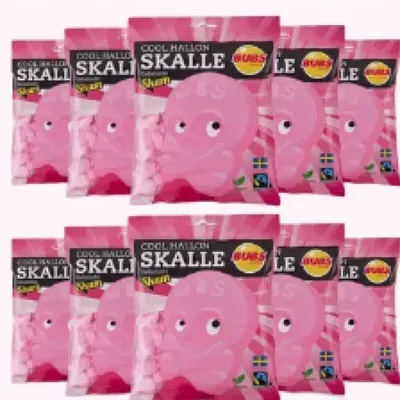
Skum is the Swedish word for the airy, whipped foam candy that gives a Swedish bag its distinctive soft pieces: foam strawberries, foam bananas, foam mushrooms, and the foam-and-gum skull that made Swedish candy go viral in the US. The texture is somewhere between marshmallow and mousse, lighter than a gummy and quicker to dissolve. Our Swedish foam candy explainer covers how it is made and why it matters.
Denmark has foam candy, but it is not the Danish signature the way it is the Swedish one. If you handed a Swede and a Dane the same bag of foam strawberries, only one of them would call it a childhood staple.
We import that Swedish foam tradition heavily. Franssons Foam Strawberries from Franssons is the classic skumjordgubbe and contains gelatin, so it is not vegan. BUBS Raspberry/Cool Hallonskalle skum from BUBS is the foam-and-gum skull, and it is gelatin-free and vegan.
Texture and the wine gum question
Danish candy runs firmer. The wine gum is a Danish fixture: dense, glossy, chewy, fruit-flavored, and nothing to do with wine. It asks for real jaw work. Danish licorice pieces are often firm too, sometimes genuinely hard.
Swedish candy runs softer and more varied. On one Swedish wall you will find airy skum, springy gummy, firm sour discs with a sanding-sugar coating, chewy fruit pieces, and the layered licorice slice. The range of mouthfeels is wider, which is exactly why one bag can hold twenty different pieces without getting monotonous.
For the dense chewy end of our own range, the Lonka bon bons come closest. Lonka Soft Bites Strawberry Bon Bon is gelatin-free.
Shapes
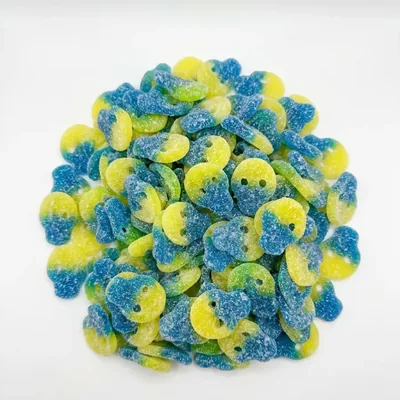
Sweden wins on shapes, and it is not close. Skulls, pacifiers, fish, mushrooms, rockets, cars, bottles, raspberry shots. The shape is part of the product, and it is a huge part of why Swedish candy photographs well and sells on social.
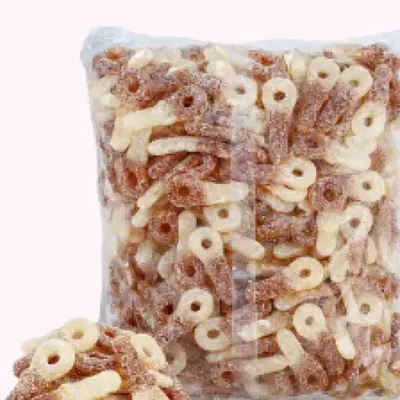
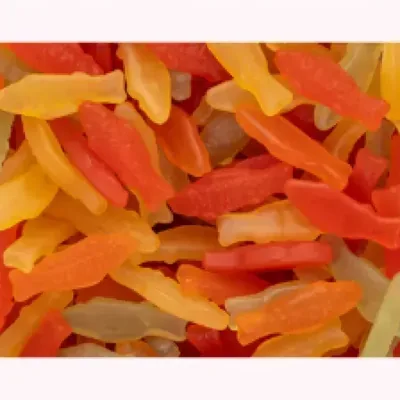
We carry that range deep. Matthijs Swedish Skulls from Matthijs is gelatin-free and flagged gluten-free, halal, vegan and vegetarian. Sura Colanappar (Sour Cola Pacifiers) is gelatin-free and contains wheat and gluten. Pastel Fish is gelatin-free and is the real Swedish pastel fish, not the American import that borrowed the name.
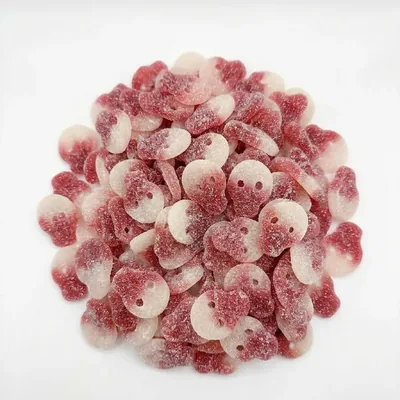
There is one Danish shape in our range, and it is worth being precise about. Matthijs Danish Skulls is a red and white flag-colored skull made in the Netherlands by Matthijs. It is a nod to Denmark, not a Danish product. It is gelatin-free, and like the rest of the Matthijs skulls it is flagged gluten-free, halal, vegan and vegetarian.
Both sides of the Nordic wall

Pick-and-mix culture
Both countries buy candy loose, by weight, from open bins. That shared habit is the single strongest thing Danish and Swedish candy have in common, and it is the part Americans most often miss.
In Denmark it is bland selv slik, "mix it yourself candy," and the ritual attaches to Friday. In Sweden it is lösgodis or smågodis, and the ritual attaches to Saturday: lördagsgodis. One bag, one day a week, built by the person eating it. We covered the Swedish habit in why Swedes eat candy on Saturdays and the mechanics of the bag in the lösgodis pick-and-mix bag.
The commercial consequence matters for a US retailer. Because the assumption is one self-built bag rather than a sealed pack, both cultures expect breadth. A wall with eight bins reads as thin in Copenhagen or Stockholm. That is why a Nordic-style pick-and-mix in the US needs twenty or more faces to feel authentic, and why we sell in cases you can mix and match.
Which one should you actually buy?
If you love licorice, especially salty licorice, Denmark is your country and you should source from a Nordic specialty importer, because we do not stock Danish brands and nothing in our catalog is salmiak or salty licorice.
If you love sour, fruity, foam-textured candy in a hundred shapes, Sweden is your country, and that is what we import. Our range is Swedish lines plus European producers we buy direct from: Dutch Matthijs and Frisia, Italian Bulgari, Spanish Vidal, and German chews from Haribo.
For most American shoppers and most American stores, the Swedish side is also the easier sell. Sour and foam candy converts broadly. Salty licorice converts narrowly and passionately.
For retailers
Anchor a Nordic shelf with Swedish lines, keep Danish licorice as a small specialty addition if you want the authenticity signal, and do not expect licorice to carry the category. Our Scandinavian candy wholesale guide covers sourcing the region and building the assortment.
We import direct and ship from our Santa Fe Springs, California warehouse to the US and Canada. Pricing is DDP, so US labels and duties are already paid and there is nothing for you to clear. Order by the case, mix and match, with no order minimum.
Building the Nordic side of your shelf? Browse the catalog or by brand, start a bulk order, or apply for a wholesale account. Want help splitting the assortment? Get in touch.
Frequently asked questions
What is the main difference between Danish and Swedish candy?+
Denmark leads with licorice, salty licorice, and wine gums. Sweden leads with sour gummies and foam (skum) candy in a very wide range of shapes. Both buy candy loose by weight.
Which has stronger licorice, Denmark or Sweden?+
Denmark. Licorice is a mainstream everyday category there and is treated as a craft. Sweden has salty licorice but keeps it as one section of a broader wall. Finland is stronger than both.
What is skum candy?+
Skum is the Swedish airy foam candy, lighter than a gummy and softer than marshmallow, used for foam strawberries, bananas, mushrooms, and the foam-and-gum skulls. It is a Swedish signature more than a Danish one.
Is bland selv the same as lösgodis?+
Practically, yes. Both are pick-and-mix walls of loose candy sold by weight. The Danish ritual attaches to Friday and the Swedish one to Saturday.
Do you sell Danish candy?+
We do not stock Danish brands, and nothing in our catalog is salmiak or salty licorice. We do carry Matthijs Danish Skulls, a Dutch-made flag-colored skull, which is a tie-in rather than a Danish product.
Which sells better in a US store?+
Swedish candy, in our experience. Sour and foam pieces and distinctive shapes appeal broadly to American shoppers, while salty licorice has a small and very committed audience.
Keep reading

Gustav Lindqvist · Candy Master
Gustav grew up in Sweden on a strict Saturday-candy schedule, mixing his lördagsgodis bag at the lösgodis wall before he could spell salmiak. He has spent years tasting his way across Scandinavian candy, and now curates the range at TheSweetsTruck, from BUBS sour skulls to the saltiest licorice most people cannot finish.
Last updated 8/7/2026