How Many Pieces Are in a Case of Candy?
Work out pieces per case, per kilo and per pound for bulk candy. Typical piece weights by candy type, worked examples on real case sizes, and cost per piece.

Divide the case weight by the average piece weight. Most bulk candy pieces sit between 2 g and 8 g, so a 1 kg case holds roughly 125 to 500 pieces and a 2.2 lb case holds the same. A 3 kg (6.6 lb) case of mid-size gummies usually lands between 430 and 750 pieces. Nobody counts a case at the factory, so nobody can hand you an exact number. What we can do is give you the arithmetic, the typical weight ranges by candy type, and worked examples on the actual case sizes we ship, so you can cost a bin or a party bag properly.
The maths
There is only one formula and it does not change:
> Pieces per case = case weight in grams / average piece weight in grams
Two notes before you use it.
First, the weight on the case is net candy weight, not the weight of the shipping carton. That is the number you want.
Second, average piece weight varies inside the same case. Extruded and moulded candy runs to a tolerance, and a foam piece that catches more air weighs less than the one next to it. Any single piece can be 20 percent off the mean. Over a few hundred pieces that averages out, which is why weighing a sample beats weighing one piece.
Pieces per kilo and per pound at a glance
Once you know the average piece weight, this table gives you the count without any maths.
Average piece weight: Pieces per 1 kg: Pieces per 1 lb
2 g: 500: 227
3 g: 333: 151
4 g: 250: 113
5 g: 200: 91
6 g: 167: 76
7 g: 143: 65
8 g: 125: 57
10 g: 100: 45
12 g: 83: 38
15 g: 67: 30
For your own numbers: pieces per kg is 1,000 divided by the piece weight in grams, and pieces per pound is 453.6 divided by the piece weight in grams.
Typical piece weights by candy type
These are ranges, not published specifications. Treat them as planning figures and confirm by weighing when the number has to be exact, for instance when you are pricing a fixed-count party favour.
Candy type: Typical piece weight: Pieces per kg: Pieces per lb
Foam (skum) strawberries, mushrooms, foam skulls: 2 to 4 g: 250 to 500: 113 to 227
Foam-and-gum skull, large format: 4 to 7 g: 143 to 250: 65 to 113
Sugar-dusted gum skull: 3 to 6 g: 167 to 333: 76 to 151
Sour disc or wine gum: 4 to 7 g: 143 to 250: 65 to 113
Sour pacifier (nappar): 5 to 8 g: 125 to 200: 57 to 91
Fruit or licorice slice (wheel cut): 5 to 10 g: 100 to 200: 45 to 91
Fish shape: 3 to 5 g: 200 to 333: 91 to 151
Wrapped chew: 4 to 6 g: 167 to 250: 76 to 113
XL sour piece: 8 to 15 g: 67 to 125: 30 to 57
Sugar cube: 2 to 4 g: 250 to 500: 113 to 227
Foam is the outlier and it is worth understanding why. Skum is aerated, so it takes up a lot of bin volume for very little weight. A foam bin looks generous and full while holding a fraction of the mass of the sour disc bin beside it. That is a merchandising advantage and a shrinkage risk at the same time, which we cover in how to run pick and mix. The format itself is explained in Swedish foam candy.
Worked examples on real cases
Using the case weights from our own catalogue and the ranges above. The planning figure is the number we would actually use to build a forecast.
Case: Net weight: Piece range: Pieces per case: Planning figure
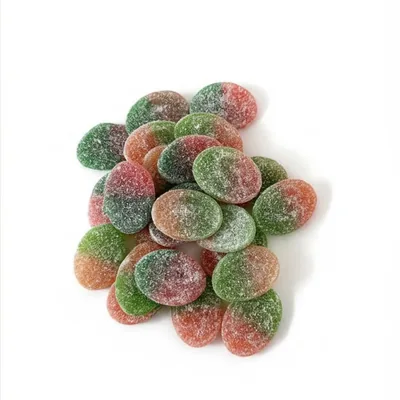
S Marke Sour Strawberry: 8.81 lb (4 kg): 4 to 7 g: 570 to 1,000: ~730
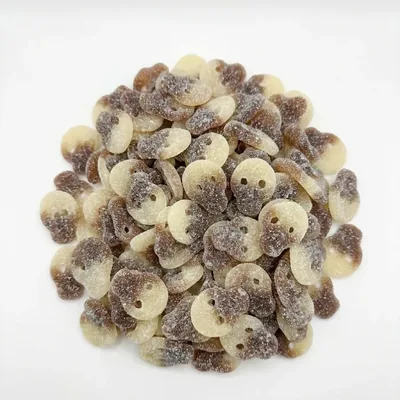
Matthijs Cola Skulls: 4.41 lb (2 kg): 3 to 6 g: 330 to 670: ~450
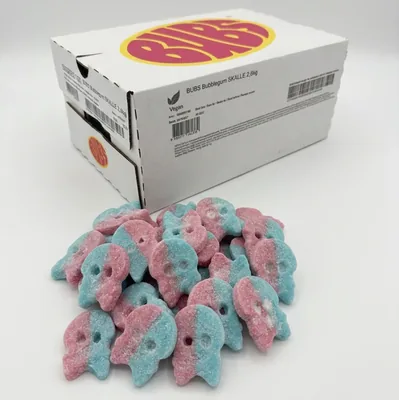
BUBS Bubbelgum Skulls: 2.6 kg (5.73 lb): 4 to 7 g: 370 to 650: ~470
Franssons Foam Mushrooms: 2.2 lb (1 kg): 2 to 4 g: 250 to 500: ~330
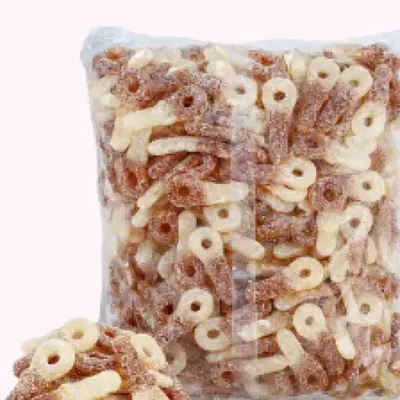
Sura Colanappar: 6.61 lb (3 kg): 5 to 8 g: 375 to 600: ~460
Sour Swedish Fish: 7.16 lb (3.25 kg): 3 to 5 g: 650 to 1,080: ~810
The spread is wide because the input range is wide. If a 30 percent margin of error breaks your plan, weigh a sample. If you are just deciding how often a bin needs refilling, the planning figure is enough.
Cost per piece
Once you have a piece count, cost per piece is simple: case price divided by pieces per case.
Take the Matthijs Swedish Skulls at the Tier 1 list price shown in the catalogue at the time of writing. A 4.41 lb case at roughly 450 pieces works out around 6 cents a piece, and the full range of 330 to 670 pieces puts it somewhere between 4 and 8 cents. That is the number that matters if you are building goodie bags or a fixed-count favour, because your customer counts pieces, not grams.
For a scoop wall you almost never need cost per piece. You need cost per pound against your retail price per pound, which is the calculation in how to price Swedish candy and candy profit margins.
Cases used in the examples above
How to get an exact number yourself
Five minutes with a kitchen scale beats any table on the internet.
1. Tare a bowl on a scale that reads to 1 g.
2. Count out 20 pieces, taken from different parts of the case so you are not sampling one tray.
3. Weigh them and divide by 20. That is your average piece weight.
4. Divide the case weight in grams by that figure.
Twenty pieces is enough for planning. If the count is contractual, use 50. Write the result on the shelf label or in your inventory sheet, because it will not change materially between cases of the same product.
The one case type where this does not apply
Display cases are counted in packs, not pieces. Our BUBS 90 g cases hold 12 bags, so a case of BUBS Goody Banana/Toffee is 12 sellable units and 1.08 kg (2.38 lb) of candy. If you are stocking a counter or a checkout basket, that is the number you plan around, and the pieces inside each bag only matter to the person eating them.
Frequently asked questions
How many pieces are in a kilo of candy?+
Between 125 and 500 for most bulk candy, depending on piece size. Divide 1,000 by the average piece weight in grams. A 5 g gummy gives 200 pieces per kilo, a 3 g foam piece gives about 333, and a 10 g XL piece gives 100.
How many pieces are in a pound of candy?+
Divide 453.6 by the average piece weight in grams. A 5 g piece gives about 91 per pound, a 3 g piece about 151, and a 10 g XL piece about 45.
How many gummies are in a 6.6 lb case?+
A 6.6 lb case is 3 kg. At 5 to 8 g per piece that is roughly 375 to 600 pieces, and at 4 to 7 g it is roughly 430 to 750. Weigh 20 pieces from the case to narrow it down.
Why does the piece count vary so much within one candy type?+
Moulded and extruded candy runs to a weight tolerance rather than an exact target, and aerated candy varies more than dense candy because the amount of trapped air differs piece to piece. Averaging over 20 pieces removes almost all of the noise.
Do you publish exact piece counts per case?+
No, and we would rather say so. Our suppliers specify cases by net weight, not by count, so any piece count we printed would be our own estimate. If you need a firm number for a specific case, [get in touch](/contact) and we will weigh a sample from current stock and tell you what we actually measured.
Which candy gives the most pieces per dollar?+
Small foam pieces, by a wide margin, because they weigh so little. If your goal is visible quantity in a bag rather than mass, foam mushrooms and foam strawberries do more work per pound than anything else we carry.

Gustav Lindqvist · Candy Master
Gustav grew up in Sweden on a strict Saturday-candy schedule, mixing his lördagsgodis bag at the lösgodis wall before he could spell salmiak. He has spent years tasting his way across Scandinavian candy, and now curates the range at TheSweetsTruck, from BUBS sour skulls to the saltiest licorice most people cannot finish.
Last updated 9/13/2026