German Candy: A Guide Beyond the Gummy Bear
German candy is more than the gummy bear. The sourced history of Haribo, MAOAM, Katjes licorice, protected Lübeck marzipan, Werther's and Ritter Sport, how it differs from Swedish candy, and the one German line we stock.
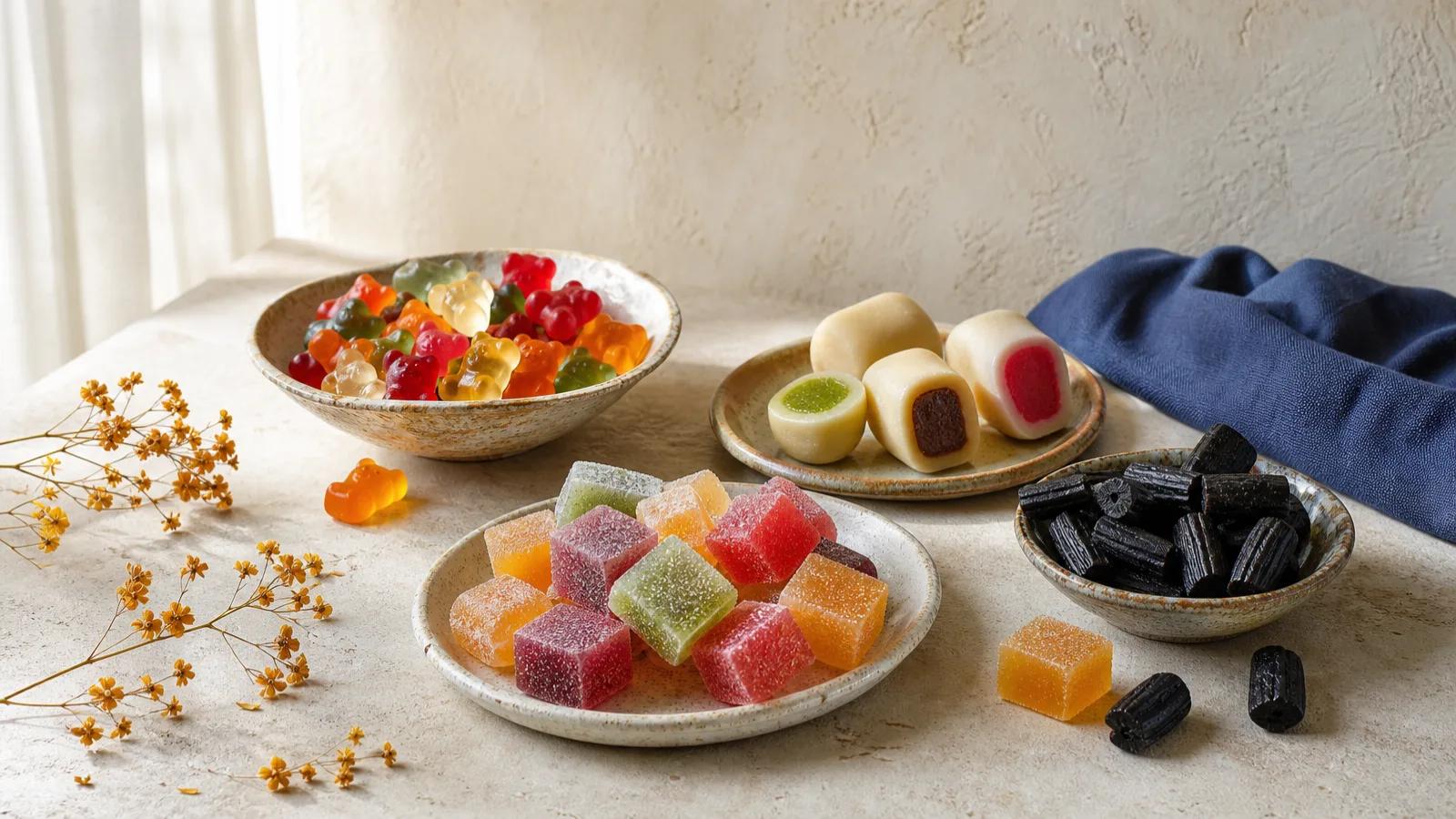
German candy includes the gummy bear: Smithsonian Magazine calls Haribo's bears the world's first gummy bears, starting with the Dancing Bear in 1922. Germany also makes MAOAM fruit chews, Katjes licorice, Lübeck marzipan, Werther's caramels and Ritter Sport chocolate. We import one German line, Haribo's Happy Chews, and this guide covers the rest as context.
We import European candy for shops across the US and Canada, including that one German line. Each dated fact below links to its source where it first appears: the maker's own history page, an official register or a major publication.
Who invented the gummy bear?
Hans Riegel did, in Bonn. He founded Haribo on December 13, 1920, according to the company, starting in a home kitchen with a sack of sugar, a copper pot and a rolling pin. The name joins the first letters of HAns RIegel BOnn, as Smithsonian Magazine notes.
In 1922 he launched the Dancing Bear (Tanzbär), which Smithsonian describes as larger and slimmer than today's bear. The Goldbear name followed in 1960.
America came later. The Herman Goelitz Candy Company, now Jelly Belly, made the first American gummy bears in 1981, and Haribo opened its first US office, in Baltimore, in the early 1980s.
What is MAOAM, and why is it not a gummy?
MAOAM is Haribo's chewy fruit candy, but it started somewhere else. Edmund Münster took over a licorice company in 1900 and launched MAOAM in 1931, and Haribo bought his company in 1986, per Haribo's MAOAM page.
As our MAOAM candy guide describes it, a MAOAM chew is soft and taffy-like rather than bouncy, so it eats slowly and fills a different slot from a gummy. That guide also covers how shops merchandise it.
Is German licorice like Dutch licorice?
Katjes, a German candy maker, has a Dutch name. Klaus Fassin founded it in Emmerich am Rhein in 1950, and tiny black licorice cats were an early favorite. Katjes explains that katjes is the Dutch word for kitten, and that its founder saw the cat as a lucky charm.
Dutch licorice, drop, is its own category, running from sweet to double-salt, and our Dutch candy guide explains it style by style. We do not import German or Dutch licorice.
Why is Lübeck marzipan protected?
Because the name is registered. Lübecker Marzipan entered the EU register as a protected geographical indication (PGI) in 1996, in the category for bread, pastry, cakes and confectionery, next to Nürnberger Lebkuchen, under Commission Regulation (EC) No 1263/96. For most PGI products, the European Commission explains, at least one stage of production, processing or preparation takes place in the named region.
One Lübeck marzipan house with a documented history is Niederegger, which pastry chef Johann Georg Niederegger founded in Lübeck in 1806, the company records.
Which German chocolates and caramels should you know?
- Ritter Sport: Alfred Eugen and Clara Ritter founded their chocolate factory in Stuttgart-Bad Cannstatt in 1912. The square bar arrived in 1932, designed to fit a sports jacket pocket without breaking.
- Werther's Original: August Storck founded a confectionery in the town of Werther in 1903. Its butter and cream caramels launched as Werther's Echte in 1969 and became Werther's Original in the 1990s, as Storck's brands went international, per Storck.
- Kinder, which is not German: despite the German word, Kinder belongs to Ferrero, which started in Alba, Italy, in 1946 and launched Kinder Chocolate in 1968.
- German chocolate cake, which is not German either: NPR explains that the name comes from Sam German, who created a sweet baking chocolate for Baker's in 1852. The chocolate only became well known in 1957, when a Texas homemaker sent her cake recipe to a Dallas newspaper.
How is German candy different from Swedish candy?
Some of this is a matter of taste, but three differences are easy to check.
- The gelling agent: Haribo's US Goldbears list gelatin as their third ingredient. Katjes, by contrast, says its fruit gum and licorice range is entirely vegetarian. The BUBS cases we import are tagged gelatin-free and vegan, and every BUBS ingredient list we hold names corn starch, most of them with potato protein.
- The texture: a MAOAM chew is soft and taffy-like, while the BUBS lines we import are listed as foam candy, which is aerated.
- The format: Swedish shops sell lösgodis, loose candy scooped from bins and sold by weight, where one bag mixes many shapes and textures.
Our retailer's comparison, Swedish candy vs Haribo, goes deeper on flavor and shelf positioning.
Which German candy do we stock?
One line. Happy Chews is a Haribo chew from the MAOAM side of the family, sold in a 4.41 lb (2 kg) case, and its Tier 1 case price is public on the product page. Our listing gives its flavor profile as apple and lemon.
We do not hold an ingredient list for this case, so we make no dietary statement about it. Check the label on the case you receive.
The German line we stock
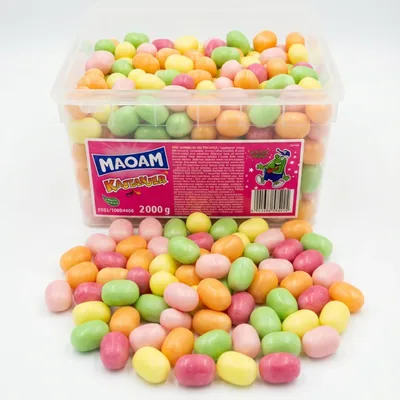
Everything else in this guide is context: we do not sell Haribo gummy bears, Katjes, Niederegger, Werther's, Ritter Sport or Kinder. For where a German chew sits beside Swedish, Dutch, Spanish and Italian lines, see our European candy guide.
German candy is worth knowing even if you only stock one line of it. To see Happy Chews beside our Swedish range, browse the store. To order by the case, apply for a wholesale account; applications approve automatically.
Frequently asked questions
What is the most famous German candy?+
There is no official ranking, but Haribo's gummy bear has a strong claim. Smithsonian Magazine calls Haribo's bears the world's first gummy bears, starting with the Dancing Bear in 1922. Other German classics with long histories include MAOAM chews, Katjes licorice cats, Niederegger marzipan, Werther's Original caramels and Ritter Sport chocolate.
Who invented gummy bears?+
Hans Riegel, who founded Haribo in Bonn in 1920, introduced the Dancing Bear in 1922. It was larger and slimmer than a modern gummy bear. The first American-made gummy bears came much later, from the Herman Goelitz Candy Company, now Jelly Belly, in 1981, and Haribo opened its first US office in the early 1980s.
Is Haribo a German company?+
Yes. Hans Riegel founded it in Bonn on December 13, 1920, and the name joins the first letters of his first name, last name and city. MAOAM became part of Haribo in 1986, when Haribo bought the Edmund Münster company that had launched the chew in 1931.
What makes Lübeck marzipan special?+
Its name is protected. Lübecker Marzipan has been an EU protected geographical indication since 1996, and for most products with that status at least one stage of production, processing or preparation takes place in the named region. Niederegger, founded in Lübeck in 1806, is one of the city's marzipan houses.
Does German candy contain gelatin?+
It depends on the maker, so check the label rather than the country. Haribo's US Goldbears list gelatin. Katjes, by contrast, says its fruit gum and licorice range is entirely vegetarian. We hold no ingredient list for the Happy Chews case we stock, so read the label on the case before you label a jar.
Do you sell German candy wholesale?+
We stock one German line, Haribo Happy Chews, in a 4.41 lb case with its Tier 1 price public on the product page. Order by the case, mix and match it with Swedish, Dutch, Spanish and Italian lines, with no order minimum. We do not stock the other German brands named in this guide.
Keep reading

Gustav Lindqvist · Candy Master
Gustav grew up in Sweden on a strict Saturday-candy schedule, mixing his lördagsgodis bag at the lösgodis wall before he could spell salmiak. He has spent years tasting his way across Scandinavian candy, and now curates the range at TheSweetsTruck, from BUBS sour skulls to the saltiest licorice most people cannot finish.
Last updated 9/24/2026