What Is Licorice Candy? A Plain Explainer
Licorice candy is candy flavoured with extract from the root of the licorice plant, Glycyrrhiza glabra. The root is boiled down into a dark concentrate, then cooked with sugar and a binder s

Licorice candy is candy flavoured with extract from the root of the licorice plant, Glycyrrhiza glabra. The root is boiled down into a dark concentrate, then cooked with sugar and a binder such as flour, starch or gelatin. The result can be sweet, salty, soft, hard or coated, depending on the country making it.
The plant
Licorice is a perennial legume, related to peas and beans, that grows across the Middle East, southern Europe and parts of Asia. Nobody eats the leaves. The value is underground, in a spreading root system that takes about three years to be worth harvesting.
Those roots store glycyrrhizin, the compound that makes licorice taste the way it does. Glycyrrhizin is far sweeter than sugar, somewhere in the range of thirty to fifty times, but it behaves nothing like sugar on the tongue. It arrives slowly, spreads sideways, carries a faint bitterness and lingers long after you have swallowed.
From root to extract
Harvested roots are washed, chopped and boiled. The liquid is filtered and reduced until it becomes a thick, almost tarry paste, then dried into hard blocks. Confectioners call this block juice or licorice block, and it is the raw material every real licorice candy starts from.
Worth knowing: only a small share of the world's licorice extract ends up in candy. Most goes into tobacco, pharmaceuticals, brewing and soft drinks, where it rounds off bitter edges.
How extract becomes candy
The candy step is simple in outline. Licorice extract is dissolved into a hot syrup of sugar and glucose, a binder is added to give the finished piece structure, then flavour and colour go in. The mass is extruded through a shaped die, cut, dried in warm air for anywhere from a few hours to several days, and finally polished with a food-grade wax so the pieces do not stick together.
The binder is what decides the mouthfeel, and it varies by country.
Binder: Typical mouthfeel: Where it is common
Wheat flour: Soft, bendy, bread-like chew: US, UK, Australia
Starch: Firm, clean bite, can go leathery: Netherlands, Nordics
Gelatin: Bouncy, gummy: Mixed, common in modern lines
Gum arabic: Dense, slow-dissolving pastille: Traditional pastilles and lozenges
Two extras change the whole character. Ammonium chloride, known as salmiak, makes licorice salty rather than sweet. Anise or star anise oil adds the sharp perfumed top note that most Americans actually think of as the licorice smell, even though it comes from a different plant entirely.
The main families of licorice candy
Family: What it is: Texture: Sweet or salty
Soft chew: Extruded ropes, laces, cats, coins: Bendy, yielding: Usually sweet
Hard licorice: Low moisture, dried longer or boiled hard: Firm to rock hard: Either
Coated: Licorice centre in chocolate, sugar shell or fruit coating: Crisp outside, chewy inside: Sweet
Salty licorice: Dosed with ammonium chloride: Firm or hard: Salty, sometimes intensely
Rope and lace: Long extruded strands, often wheat based: Soft, chewy: Sweet
Layered slices: Chewy base with a softer second layer, cut into slices: Two textures in one bite: Sweet
Most national styles are a combination of these. Dutch drop alone runs to dozens of shapes and salt levels. Danish licorice leans on chocolate and caramel coatings. Finnish salmiakki pushes the salt further than anywhere else. Our guide to salty licorice and salmiak covers that end of the spectrum, and Swedish vs Dutch licorice explains why the two biggest traditions taste so different.
Is licorice candy actually good for you?
It is candy, so the honest answer is no more than any other candy. Licorice root has a long history in traditional medicine, mostly for coughs and stomach complaints, but a bag of licorice is mostly sugar. Glycyrrhizin itself is worth respecting in quantity: it can lower potassium and raise blood pressure, and the FDA has published a consumer note about adults over 40 eating around two ounces of black licorice daily for two weeks or more. Normal snacking is not the concern, daily habit is.
What licorice candy is not
Red licorice contains no licorice. Neither does most black candy sold in US supermarkets under an anise flavour. If the ingredient panel does not say licorice extract, liquorice or Glycyrrhiza, you are eating something shaped like licorice, flavoured like anise, and named after a plant it has never met.
Where our catalogue sits
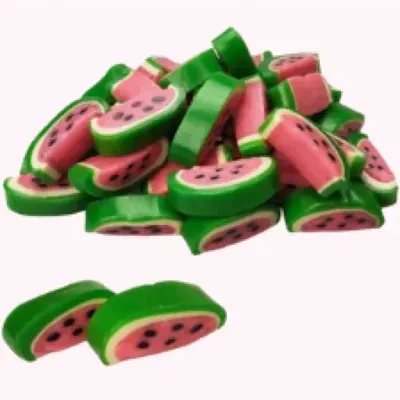
We import Swedish, Dutch and Spanish candy into California, and our current range is fruit and sour led rather than black licorice. The licorice-family format we do carry is the layered slice, a Nordic classic built as a chewy base with a softer top layer, in fruit flavours. Below are those two slices plus a couple of the lines most often ordered alongside them. Case prices are public on every product page.



Frequently asked questions
What is licorice candy made from?+
Licorice root extract, sugar and glucose syrup, and a binder that sets the texture. Wheat flour, starch, gelatin or gum arabic all appear depending on the country and the style. Molasses, caramel colour, anise oil and, in salty versions, ammonium chloride are common additions.
Is licorice candy the same as licorice root?+
No. Licorice root is the raw plant material, sold as sticks, tea or supplements. Licorice candy is confectionery made with a concentrated extract of that root plus sugar and a binder. The candy contains far less licorice and far more sugar than the root itself.
Why do Americans and Europeans mean different things by licorice?+
In the US, licorice became a shape word for extruded ropes, and the most popular ones are red and contain no licorice at all. In northern Europe, licorice stayed a flavour word, and the reference product is a dark, root-flavoured, often salted candy eaten mainly by adults.
Does licorice candy contain gluten?+
It depends entirely on the binder. Licorice built on wheat flour, which covers most American, British and Australian ropes, contains gluten. Licorice built on starch or gelatin often does not. Always check the label rather than the colour, and check the specific product rather than the brand.
What is salty licorice?+
Licorice candy dosed with ammonium chloride, or salmiak, instead of leaning on sugar. It tastes saline for a second, then turns sharp and slightly numbing. Finland and the Netherlands make the strongest versions. Sweden, Denmark and Norway make gentler ones. We cover it in detail in [what is salmiak](/journal/what-is-salmiak).

Gustav Lindqvist · Candy Master
Gustav grew up in Sweden on a strict Saturday-candy schedule, mixing his lördagsgodis bag at the lösgodis wall before he could spell salmiak. He has spent years tasting his way across Scandinavian candy, and now curates the range at TheSweetsTruck, from BUBS sour skulls to the saltiest licorice most people cannot finish.
Last updated 8/23/2026