How to Run a Candy Buffet: The Complete Guide
A practical guide to running a candy buffet: vessels, variety, colour scheme, labelling, scoops and bags, hygiene and setup order, from a bulk candy importer.

A candy buffet is a self-serve table of loose candy in open vessels, with a scoop for each vessel and bags for guests. Get five things right and it works: a mix of vessel heights, six to twelve varieties across different textures, one colour palette, a clear label on every vessel, and simple hygiene discipline. We supply the candy for a lot of these, in bulk, to planners and shops. This is the running order we would use ourselves, from empty table to packed-down.
What a candy buffet actually is
Strip away the styling and it is a self-serve display. Guests approach, take a bag or a small box, move along the table, scoop what they want, and leave with it. Everything else is decoration on top of that flow.
That flow is the thing to design around. Candy buffets fail in predictable ways: a queue that stalls because bags are at the wrong end, a vessel nobody can reach, a scoop lost inside a jar, a guest wondering what the pale green ones are. Almost every problem is a logistics problem wearing a nice tablecloth.
If you are selling this as a service rather than hosting one, the commercial side is in wedding and event candy bars and Swedish candy for parties and events. This guide is about execution.
Vessels: height, shape and the two mistakes
A candy buffet reads as a skyline, so you want three heights: tall cylinders at the back, apothecary jars in the middle, low bowls and footed dishes at the front. Cake stands and boxes under the cloth give you the back row for free.
Approximate capacities, so you can plan before you buy. Fill to about three-quarters, never to the brim, because a full-to-the-lid jar looks unservable and guests will not disturb it.
Vessel: Rough volume: Gummy or chew fill: Foam fill
Tall cylinder: 1.5 gal / 6 L: about 8 to 9 lb: about 3 lb
Standard apothecary jar: 1 gal / 4 L: about 5 to 6 lb: about 2 lb
Small apothecary jar: 0.5 gal / 2 L: about 2.5 to 3 lb: about 1 lb
Wide bowl or footed dish: about 1 gal: about 4 to 5 lb: about 1.5 lb
Favour jar or test tube: 50 to 100 ml: 1.5 to 3 oz: under 1 oz
Two things to note. Foam weighs roughly a third of what a gummy weighs at the same volume, so a jar of foam looks identical and costs far less. And these are approximations, so if budget is tight, fill one jar and weigh it before ordering the rest.
The two mistakes: narrow necks, which fight the scoop and trap the last third of the product, and vessels too deep to reach the bottom of without tipping. Wide mouths, moderate depth.
How many varieties
More variety is not automatically better. Past a certain point guests stop choosing and start taking one of everything, which blows through your weight budget and leaves you with twelve half-empty jars.
Guests: Varieties: Vessels
Up to 40: 5 to 6: 6 to 8
40 to 80: 6 to 8: 8 to 10
80 to 150: 8 to 10: 10 to 14
150 to 300: 10 to 12: 14 to 20
Above roughly 150 guests, add duplicate vessels of your two most popular items at both ends of the table rather than adding more varieties. That is a queue fix, not a choice fix, and it is the single most effective thing you can do for a big event.
How much total weight to buy is its own question with its own maths, and we have given it a separate guide: candy buffet quantities.
Spread the textures, not just the colours
This is the difference between a buffet that looks good in photos and one people actually eat from. Cover four textures.
Soft foam (skum). Pillowy, light, visually large. Foam strawberries and foam mushrooms fill a jar beautifully for very little weight. Background on the format is in Swedish foam candy.
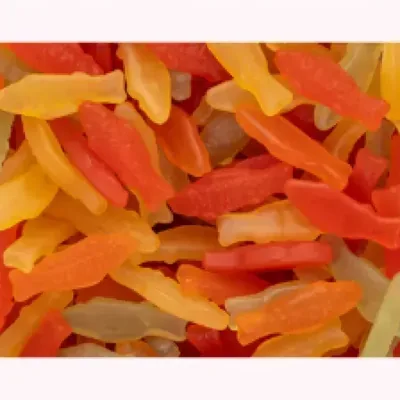
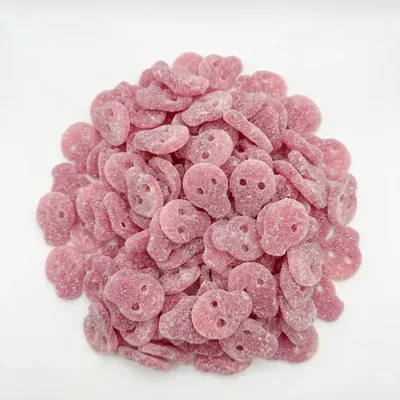
Firm gummy and chew. The workhorse. Skulls, fish, slices and rolls. This is where most of your weight should sit.
Sour. Every buffet needs at least one, usually two. Sour is the item teenagers and adults come back for, and it stops the table reading as childish.
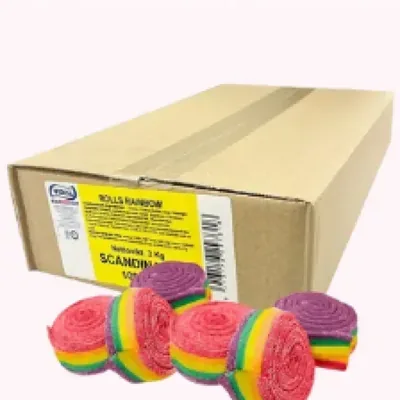
A different shape logic. Rolls, slices, pacifiers, anything that is not a small blob. Shape variety photographs better than flavour variety, because nobody can see flavour.
A four-texture buffet in four cases

Colour scheme
Pick two or three colours and one neutral, then buy to the palette rather than buying nice things and hoping. A blush, cream and gold wedding table wants pastel fish, foam strawberries and pale pink chews. A birthday wants full rainbow and can take the loudest thing you own.
Let one pale item carry the neutral. Pastels create visual rest, and a table that is bright everywhere is bright nowhere. If the palette is strict, sorting a multi-colour case by hand is legitimate and planners do it, just budget the labour honestly.
Labelling: the part most buffets skip
Every vessel gets a card, not for style but because an unlabelled jar generates a question someone has to answer forty times. Put three things on it: what it is, one honest descriptor ("soft, mild, not sour"), and any dietary information you can actually stand behind.
That last part matters. Copy dietary flags from the supplier's product page, do not infer them from an ingredients list and do not guess. Our own rule is that we publish a flag only where our supplier data carries one, which is why some items are flagged gluten-free, halal, vegan and vegetarian and others carry nothing at all. If a product has no flag, its card should say nothing about diet rather than something optimistic. Allergens are a separate and more serious matter, covered in Swedish candy allergens.
Add one general card at the head of the table noting that the candy is not individually wrapped and where guests can ask about ingredients.
Scoops, tongs and bags
One scoop or tong per vessel. Never a shared scoop, ever, and never a scoop that lives inside the candy where a hand has to go in after it. Scoop rests, small dishes or clips on the jar rim all work.
Metal tongs suit large flat pieces like slices and rolls, scoops suit small pieces. A 1 oz scoop is a useful size, because two to four scoops feels like a decent handful and gives you rough portion control without saying anything to anyone.
Bags go at the entry point, not the middle, and size them deliberately: a bag that holds a pound will be filled with a pound. A 4 to 6 oz bag is the usual sweet spot for a favour, and the tradition it borrows from is described in the losgodis bag. Put out ties if guests are travelling home, and a bin at the far end for the bag that tears.
Hygiene and running the table
Candy is shelf-stable, which makes a buffet much lower risk than a food table, but self-service still needs discipline.
Cover vessels between service windows, especially outdoors, and keep the table out of direct sun, because heat softens chews and sticks them together. Humidity is the real enemy for anything sour: the coating draws moisture and pieces go dull and tacky within a couple of hours in a humid room, so put sour items out last.
Refill by swapping in a fresh vessel rather than topping up a picked-over one. Topping up looks careless and mixes handled candy with fresh.
Assign one person to walk the table every thirty minutes: straighten scoops, close lids, wipe spills, restock bags. Thirty seconds of attention keeps a table looking styled for six hours.
Setup order
Cloth and risers, then empty vessels placed and spaced, then labels, then candy, then scoops, then bags at the entry point. Fill last so nothing sits open longer than it must, and photograph the table before a guest touches it.
Sourcing
Buy bulk cases, not retail bags. Far cheaper per pound, consistent pieces, and no packaging to hide. Order by the case, mix and match across brands, with no order minimum, and order two weeks out so a delayed box is not an emergency. Unopened cases keep well, so over-ordering slightly is cheap insurance rather than waste. Storage advice is in Swedish candy shelf life.
Frequently asked questions
How many types of candy should a candy buffet have?+
Five or six varieties for a small event, eight to ten for around 100 guests, and ten to twelve at the top end. Beyond twelve, duplicate your two most popular vessels at both ends of the table instead of adding more choices.
What do you put candy in for a candy buffet?+
Open, wide-mouthed vessels at three different heights: tall cylinders at the back, apothecary jars in the middle, bowls and footed dishes at the front. Fill to about three-quarters, and avoid narrow necks that fight the scoop.
Do you need labels on a candy buffet?+
Yes. Every vessel should name the candy, describe it in a few words, and carry any dietary information you can actually verify from the supplier. Unlabelled jars generate the same question over and over.
Is a candy buffet a food safety risk?+
Lower than most food tables, since candy is shelf-stable, but self-service still needs one scoop per vessel, lids between service windows, no shared utensils and no direct sun. Refill by swapping vessels rather than topping up.
How far in advance can you set up a candy buffet?+
Build the table ahead, but fill the vessels as late as practical, ideally within an hour or two of guests arriving. Put sour items out last, because they take up moisture quickly.
Where do you buy candy for a candy buffet?+
Buy bulk cases from a wholesaler rather than retail bags. Far cheaper per pound, and the pieces are consistent. We ship cases across the US and Canada with no order minimum.

Gustav Lindqvist · Candy Master
Gustav grew up in Sweden on a strict Saturday-candy schedule, mixing his lördagsgodis bag at the lösgodis wall before he could spell salmiak. He has spent years tasting his way across Scandinavian candy, and now curates the range at TheSweetsTruck, from BUBS sour skulls to the saltiest licorice most people cannot finish.
Last updated 8/23/2026