Licorice Rope Candy: How Ropes and Laces Are Made
Licorice rope is extruded, not molded. How the paste is cooked and pushed through a die, how filled laces are co-extruded, and how ropes work on a pick-and-mix wall.

Licorice rope is extruded candy. A cooked paste of flour or starch, sugar syrup, molasses and licorice extract is forced through a shaped die, cut to length, and then cured in a warm room until it firms up. Filled laces are co-extruded, with a soft center piped down the middle of the strand as it forms. Ropes and laces are the highest-drama item on a bulk candy wall and the most misunderstood one behind the counter. Here is how they are made and how to sell them without losing money to dried-out stock.
The extrusion line
Every rope, lace, bootlace, wheel and coil comes off the same basic line.
1. Cook the paste. Sugar syrup, glucose, molasses and a binder are cooked together to drive off water. Licorice extract and anise oil go in near the end.
2. Push it through a die. The hot paste is forced through a plate with holes cut in the desired profile. A round hole gives a rope. A flat slot gives a lace or belt. A star, a gear or a fluted hole gives a textured rope. Change the plate, change the product.
3. Cool and cut. The continuous strand is cooled on a belt, then cut to length, coiled into wheels, or wound onto reels.
4. Cure. This is the step nobody sees. The cut pieces sit in a warm, controlled room for hours or days, losing moisture until the texture settles. Undercured rope is gummy and sags. Overcured rope is a shoelace.
5. Finish. Some ropes get a light oil or wax polish so they do not stick to each other. Sour versions get tumbled in acid and sugar.
The die is the whole product design. It is why a maker can run six shapes off one recipe, and it is why rope and lace formats are cheap to extend and expensive to reinvent.
Why traditional licorice paste uses wheat flour
The binder is what holds an extruded rope together and keeps it from slumping after it leaves the die. Historically that binder is wheat flour, because it gelatinizes during cooking, sets firm on cooling, and gives licorice its characteristic dense, slightly resistant chew.
Modern lines often use modified starch or a starch and gelatin blend instead, which produces a springier, glossier rope. Neither is better. They are different eating experiences, and they land differently with different customers.
This does mean that whether a specific rope contains wheat depends entirely on the recipe, not on the format. Never assume either way from the shape of the piece. Read the pack, or ask your supplier for the spec. We publish only the dietary flags our supplier data actually carries, for reasons we set out in Swedish candy allergens.
Solid versus filled
Filled laces are made by co-extrusion. Two feeds run into the same die head, an outer annulus and an inner channel, so a soft center is piped down the middle of the strand as it forms. Cut it and you can see the core.
Format: Build: Typical use
Solid rope: Single extrusion, round or fluted die: Classic licorice rope, dense chew
Lace or belt: Flat slot die, thin cross section: Sour belts, tangles, kids' formats
Filled lace: Co-extruded, soft center in a firm sleeve: Fruit-filled twists, cream-center ropes
Wheel or coil: Continuous strand wound rather than cut: Visual centerpiece, sold by the piece
Cut-to-order rope: Long strand sold by length or weight: Counter theater, high perceived value
Filled versions are softer overall and dry out faster, because the core carries more moisture and it migrates. That is a merchandising fact, not a quality problem.
Red licorice is not licorice
Worth saying plainly, because it comes up at the counter constantly. Strawberry twists and other red ropes are made on the same extrusion line with the same paste construction, but they contain no licorice extract at all. They are extruded fruit-flavored candy wearing the word licorice as a format name. Anyone who dislikes anise will be perfectly happy with them, and anyone who wants actual licorice will be disappointed.
Ropes on a pick-and-mix wall
Ropes and laces do things on a wall that nothing else does, and they cause problems nothing else causes.
What they do well. They are the tallest, most visible item in a bin. They photograph well. They give children a reason to point. They carry a high perceived value per piece, so a rope bin lifts the average basket next to a bin of small gummies. Our guides to running pick and mix and building a pick and mix wall cover the layout side.
What goes wrong. Ropes tangle, so a scoop pulls out more than the customer wanted and the rest lands back in the bin handled. They dry out fastest of any format because of the surface area, so a slow-moving rope bin turns to string in weeks. And they are the item most likely to be handled directly rather than scooped, which is a hygiene issue you have to design out with tongs and a narrow opening.
Practical fixes. Small bins with fast turnover rather than a big impressive bin. Keep the lid closed. Rotate rope bins more aggressively than gummy bins. If a rope is not moving, cut the facing rather than the price. Weight-based pricing across the whole wall is what keeps this simple, and we work through the numbers in how to price Swedish candy.
What we carry
Honestly: we do not currently import a licorice rope, lace or belt. Our list is Swedish and European gummy, foam, chew and sour, and the long-format extruded pieces are not on it.
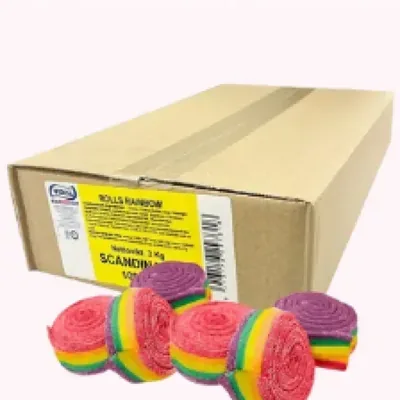
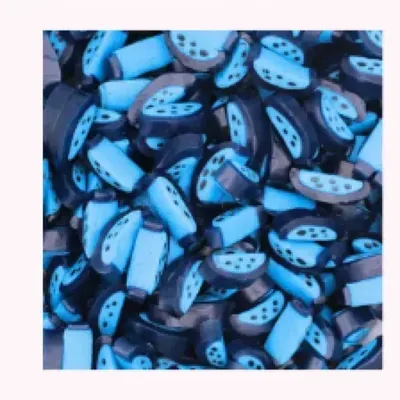
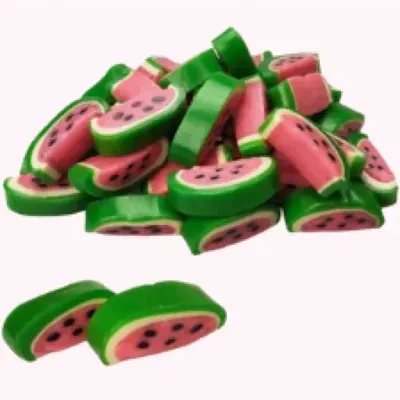
The closest thing we hold to the coiled, wound format is Rainbow Rolls, which gives you the same visual on a wall. For the extruded and sliced construction, the fruit licorice slices are the direct equivalent, cut from a laminated block rather than pulled from a die. If a rope bin is what you are after, we will tell you we are not the right supplier for that one bin rather than sell you something else and call it close enough.
Frequently asked questions
How is licorice rope candy made?+
A cooked paste of sugar syrup, molasses, a flour or starch binder and licorice extract is forced through a shaped die, cut or coiled, then cured in a warm room until it firms up. The shape of the hole in the die determines whether you get a rope, a lace or a belt.
What is the difference between licorice rope and licorice laces?+
Only the die. A rope comes from a round or fluted hole and has a dense, substantial chew. A lace or belt comes from a flat slot and is thin, flexible and faster to eat. Same recipe, same line, different plate.
How are filled licorice ropes made?+
By co-extrusion. Two streams feed one die head so a soft center is piped down the middle of the outer sleeve as the strand forms. Filled versions eat softer and dry out faster than solid rope, because moisture migrates out of the core.
Does licorice rope contain wheat?+
It depends entirely on the recipe. Traditional licorice paste uses wheat flour as the binder, while many modern lines use modified starch instead. The format tells you nothing. Read the pack or ask the supplier for the specification rather than guessing.
Is red licorice actually licorice?+
No. Red twists are extruded on the same equipment with the same construction, but they contain no licorice extract. The word licorice there describes the format, not the flavor.
Do you sell licorice rope wholesale?+
Not at present. We do not import ropes, laces or belts. The closest formats on our list are Rainbow Rolls for the coiled look and the fruit licorice slices for the firm sliced bite.

Gustav Lindqvist · Candy Master
Gustav grew up in Sweden on a strict Saturday-candy schedule, mixing his lördagsgodis bag at the lösgodis wall before he could spell salmiak. He has spent years tasting his way across Scandinavian candy, and now curates the range at TheSweetsTruck, from BUBS sour skulls to the saltiest licorice most people cannot finish.
Last updated 8/23/2026