Sugar Content in Swedish Candy: What the Labels Actually Say
Typical sugar per 100 g by candy category, how EU and US labels differ, and why format and portion matter more than which brand is on the bag.

Most Swedish candy contains roughly 45 to 70 g of sugar per 100 g. Sour and foam lines sit at the top, because a sugar coating and an aerated sugar base leave little room for anything else. Chews and licorice-style slices sit lower, because fat, flour and starch take up part of the weight.
What this page is based on
These are typical ranges for confectionery categories, based on how each type is formulated and on the nutrition panels European candy of that type normally carries. They are not measurements of individual SKUs in our warehouse, and we are not going to publish an exact gram figure for a specific line that we have not read off that line's panel.
For any case we ship, the number that counts is on the manufacturer's nutrition panel. Ask us and we will get the specification sheet from the maker. Nothing here is nutrition or dietary advice, and we are not going to tell you what any of it means for you personally.
Typical sugars by category
Category: Typical sugars, g per 100 g: What takes up the rest of the weight
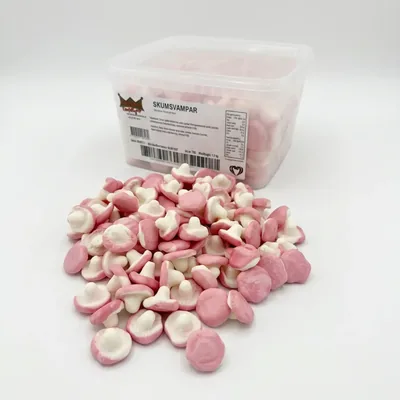
Foam (skum): 55 to 70: Glucose syrup, water, gelling and aerating agents
Sour gummy and sour foam: 55 to 70: The base, plus an acid and sugar coating on the outside
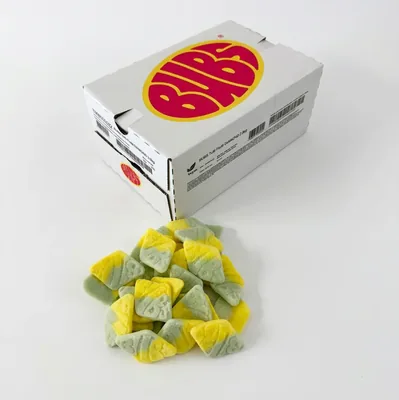
Firm gummy: 50 to 65: Glucose syrup, gelling agent, water, colours and flavours
Licorice-style slices and rolls: 45 to 60: Wheat flour or starch, syrup, fats
Chew, toffee and bon bon: 45 to 60: Fat and milk solids
Milk chocolate, for context only: 50 to 58: Cocoa butter, cocoa solids and milk fat
Two things fall out of this table. First, the spread across categories is narrower than most people expect: nearly all candy is somewhere between half and two thirds sugar by weight, and always has been. Second, the categories that look "lighter" are usually lower in sugar only because something else, normally fat or flour, is occupying the space.
Note that "sugars" on a European panel is a measured total of mono and disaccharides. It includes the glucose syrup, so it is not the same as the amount of white sugar tipped into the mixer.
Why the same candy shows two different numbers
This is the source of most of the confusion, and it is a labelling difference rather than a recipe difference.
: European panel: US Nutrition Facts
Basis: Always per 100 g, sometimes per portion as well: Per serving, using an FDA reference amount
Sugar line: "Carbohydrate, of which sugars": "Total Sugars", with "Includes X g Added Sugars"
Percent daily value: Not shown for sugars: Shown for added sugars
A European bag might declare 62 g of sugars per 100 g. The US version of the same product declares the sugars in a 40 g serving instead, which reads as roughly 25 g, and adds an Added Sugars line underneath. Nothing about the candy changed. Only the denominator did.
For candy that is essentially sugar and syrup, total sugars and added sugars are close to identical, since there is little or no naturally occurring fruit sugar in the recipe. We cover what an importer has to do with all of this in FDA candy labeling.
If you are comparing two products, convert both to per 100 g before you draw any conclusion.
Swedish candy versus American candy
Per 100 g, there is no meaningful gap. Sugar and glucose syrup behave the same in Malmo as they do in Michigan. What actually differs is everything around the sugar.
Format. The Swedish default is losgodis, sold loose by weight, where the customer decides the portion at the scoop. The American default is a sealed bag or bar with the portion decided in a factory. That single difference does more to shape how much anybody eats than any recipe change. See losgodis and the pick and mix bag.
Occasion. Sweden concentrates candy buying into Saturday, a habit with its own name and its own aisle behaviour. Why Swedes eat candy on Saturdays explains where that came from.
Flavour direction. Swedish recipes lean much harder on acid and on salt, particularly salmiak, than American ones do. That changes how sweet a piece tastes without changing how much sugar is in it. What is salmiak covers the salty licorice end.
We compared the two traditions in full in Swedish candy vs American candy, and looked at the claim head on in is Swedish candy healthier.
Brand is the wrong variable
Within a category, competing brands land within a few grams of each other per 100 g, because they are solving the same technical problem with the same ingredients. Switching from one sour gummy to another moves the number very little.
What moves it a great deal is format and portion: bag size, scoop size, whether a bin sits at eye level, whether the piece is a 3 g foam mushroom or a 10 g slice. For a retailer that is a merchandising question rather than a sourcing one, and how to run pick and mix is where we go into it.
For the calorie side of the same question, see Swedish candy calories.
On sugar-free lines
We do not carry any sugar-free or reduced-sugar candy. Everything in our catalogue is conventional sugar and glucose syrup confectionery, and we would rather say that plainly than have a buyer discover it after ordering. If a sugar-free section is a requirement for your shelf, source it elsewhere and keep our lines for the pick and mix wall.
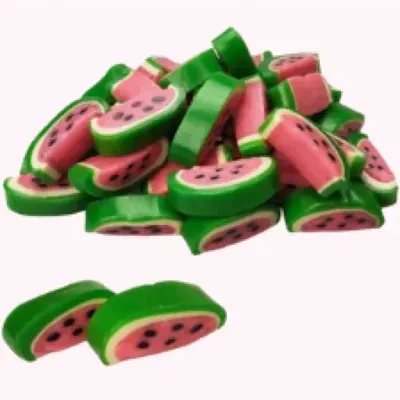
One line from each of the main sugar categories
Frequently asked questions
How much sugar is in Swedish candy?+
Typically 45 to 70 g per 100 g, depending on category. Sour and foam lines sit at the top of that range because of the sugar coating and the aerated sugar base. Chews and licorice-style slices sit lower because fat and flour take up part of the weight.
Does Swedish candy have less sugar than American candy?+
No, not in any consistent way. Compared on the same per 100 g basis, the two land in the same range, because they are built from the same sugar and glucose syrup. The differences are in format, portioning and flavour direction rather than in sugar content.
Why does the sugar figure on a Swedish bag look different from a US one?+
Because European panels declare per 100 g while US Nutrition Facts declare per serving, using an FDA reference amount. A 62 g per 100 g figure becomes roughly 25 g on a 40 g serving. Same candy, different denominator.
Which candy category has the most sugar per 100 g?+
Sour lines and foam, generally. Sour pieces carry a sugar and acid coating on top of an already sugar-based centre, and foam is aerated sugar with very little else in it. Chews and toffees are lower per 100 g because fat displaces some of the sugar.
Do you sell sugar-free Swedish candy?+
No. Our catalogue is conventional sugar confectionery across every line we import, with no sugar-free or reduced-sugar SKUs. If you need that section, source it separately.
How do I get the exact sugar figure for a specific case?+
Ask us for the manufacturer specification sheet on that line. It carries the full nutrition panel per 100 g, and it is the only figure to use for a shelf tag, a menu board or anything with a compliance requirement.

Gustav Lindqvist · Candy Master
Gustav grew up in Sweden on a strict Saturday-candy schedule, mixing his lördagsgodis bag at the lösgodis wall before he could spell salmiak. He has spent years tasting his way across Scandinavian candy, and now curates the range at TheSweetsTruck, from BUBS sour skulls to the saltiest licorice most people cannot finish.
Last updated 8/23/2026