Swedish Gummies: What Makes Them Different
What separates Swedish gummies from American ones: firmer chew, sharper sourness, the wine gum tradition, and which of ours are flagged gelatin-free or vegan.

Swedish gummies are firmer and chewier than American ones, sourer at the surface, and far more likely to be made without gelatin. The chew comes from the wine gum tradition, the sourness from acid coatings rather than acid in the body, and the gelatin-free part from European makers moving to plant-based gelling agents earlier than the US industry did. "Swedish gummies" is a loose phrase covering several distinct formats. Here is what actually separates them, and what we can and cannot tell you about the ingredients.
The texture is the real difference
Bite an American gummy bear and it gives quickly and dissolves. Bite a Swedish gum skull or a sour disc and it pushes back, then chews for noticeably longer.
That comes from the vingummi, or wine gum, tradition. Wine gums are a firm, dense, glossy style of gum built to be chewed rather than melted, and they are the ancestor of a lot of what sits on a Swedish candy wall today. Despite the name there is no wine in them. The style spread across northern Europe and Sweden took to it thoroughly.
The practical consequence for a retailer is that Swedish gummies hold their shape in a bin much better than soft American gummies do. They resist deforming under their own weight, they do not fuse into a block as readily, and they survive being scooped repeatedly. That is a real operational advantage on a pick-and-mix wall, and it is one reason the format travels well. More on the format taxonomy in Swedish candy textures and Swedish gummy candy.
Not everything Swedish is firm, though. Foam candy sits at the opposite end, light and collapsing, and the two textures next to each other are much of what makes a Swedish wall feel different from an American one.
The sourness works differently
American sour candy usually gets its kick from a sanding sugar coating that hits hard and disappears fast. Swedish sour candy tends to do two things at once: a genuinely aggressive acid coating, and a fruit body underneath with enough acidity of its own that the sourness does not simply vanish after two seconds.
The result is sourness that lasts through the chew rather than sitting on top of it. On the extreme end you get formats built entirely around the hit, like the sour shots and the super sour cases. In the middle you get the everyday sour disc, sour enough to be noticeable and mild enough to eat a handful of.
If you are choosing between them, best Swedish sour candy and Swedish sour candy types sort the formats by intensity.
Gelatin, vegan and gluten: what our data says
This is the part people actually search for, so we will be precise about it. Everything below comes from the dietary flags in our own product records. Where we hold no flag, we publish nothing rather than guess.
Line: Format: Flags on our records
Matthijs skulls and cola bottles, all seven cases: Sugar-dusted gum: Gluten-free, halal, vegan, vegetarian
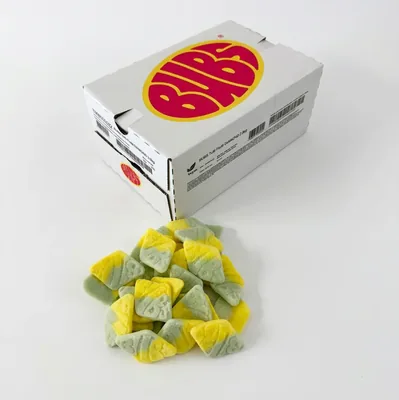
BUBS bulk cases and 90 g bags: Foam and gum: Gelatin-free and vegan across the flagged range, several also halal
S-Marke sour discs: Sour wine gum style: Vegan, and four of the five also halal
Sura Colanappar and Melonnappar: Sour pacifier: Halal, vegan
Everything else in the range: Various: No dietary flags on file, so we make no claim
Three things worth pulling out of that table.
A vegan flag means no gelatin. Gelatin is an animal product, so any item flagged vegan cannot contain it. That covers the whole flagged BUBS range, the Matthijs range, the S-Marke discs and the Sura pacifiers.
Gelatin-free does not mean gluten-free. These two move independently and people conflate them constantly. The Matthijs line is flagged gluten-free. The S-Marke discs and the Sura pacifiers are flagged vegan and do contain wheat. If you are serving a celiac customer, that difference is the whole answer, and putting a "gluten-free" shelf talker across a vegan bin would be a genuine mistake. Gluten-free Swedish candy goes through it properly.
No flag means no claim, not a negative claim. A blank in that table means we do not hold supplier data for that item, not that it fails the test. If you need to know about a specific case, ask us and we will tell you exactly what we have on file.
The broader question of why so many European gummies skip gelatin is covered in does Swedish candy have gelatin, and the vegan range in vegan Swedish candy.
Gummy formats worth starting with
The main formats, and who they are for
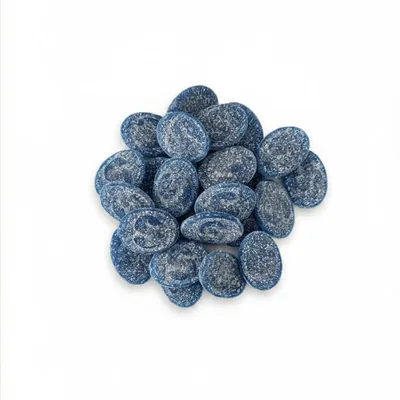
Sour discs. The S-Marke cases are the workhorse. Firm wine-gum body, hard sour coating, a single clear fruit flavour per case. They come in 8.81 lb (4 kg) cases, the largest format we carry, which suits a bin that turns over fast.
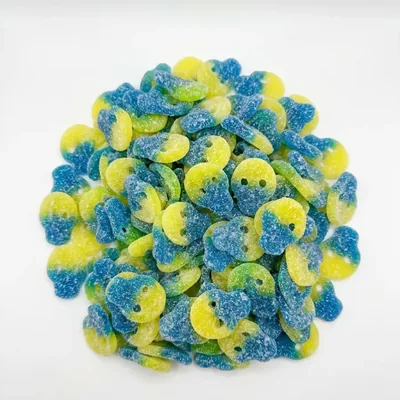
Gum skulls. The most recognisable Swedish shape in the US, and the one people photograph. Matthijs makes a sugar-dusted, matte-surfaced version in 4.41 lb (2 kg) cases across seven flavours. BUBS makes a two-texture version with a foam base and a gum face. Both are covered in the Swedish candy skulls guide.
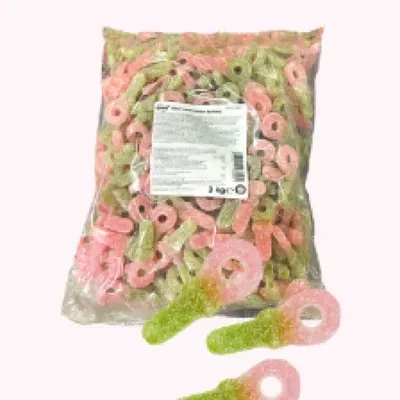
Sour pacifiers. Nappar, a Swedish classic shape, sour-coated, in 6.61 lb (3 kg) cases. Nostalgic in Sweden, novel in the US, which is a good combination for a gift shop. See sura nappar.
Fruit and licorice slices. Wheel-cut pieces with visible layers. They look good in a bin because the cut face shows, and they are heavier per piece than most formats.
Fish. The one Americans think they already know. What Swedes actually eat is not the same product, which is the subject of real Swedish fish.
Are Swedish gummies healthier?
No, and anyone telling you otherwise is selling something. They are still sugar candy. What is true is that European labelling rules and colouring conventions differ from American ones, and that many Swedish gummies use plant-based gelling agents. Those are real differences, and neither one makes candy a health food. We took the question apart in is Swedish candy healthier.
Frequently asked questions
What makes Swedish gummies different from American gummies?+
A firmer, longer chew inherited from the wine gum tradition, sourness that carries through the bite rather than sitting on the surface, and a much higher chance of being made without gelatin. They also hold their shape better in a bulk bin.
Are Swedish gummies gelatin-free?+
Many are. Our flagged ranges, BUBS, Matthijs, S-Marke and the Sura pacifiers, are all flagged vegan, which rules out gelatin. Items with no dietary flag on our records carry no claim from us either way, so check the pack.
Are Swedish gummies vegan?+
The BUBS range, the Matthijs range, the five S-Marke sour cases and the two Sura pacifier cases are flagged vegan on our records. That covers a large share of the gummy formats we carry. Other items have no flag on file.
Are Swedish gummies gluten-free?+
Some, not all. The Matthijs line is flagged gluten-free. The S-Marke discs and Sura pacifiers contain wheat despite being vegan. Never assume a vegan or gelatin-free flag implies gluten-free.
What is a Swedish wine gum?+
Vingummi, a firm dense gum with a glossy surface, built for chewing rather than dissolving. There is no wine in it. The style underpins much of the texture that people recognise as Swedish, including the sour discs.
Which Swedish gummies should a US shop stock first?+
A sour disc for volume, a gum skull for the shape people photograph, and a sour pacifier for the novelty. Three bins covers the range far better than six bins of near-identical fruit gummies. The stocking logic is in [how to stock Swedish candy](/journal/how-to-stock-swedish-candy).

Gustav Lindqvist · Candy Master
Gustav grew up in Sweden on a strict Saturday-candy schedule, mixing his lördagsgodis bag at the lösgodis wall before he could spell salmiak. He has spent years tasting his way across Scandinavian candy, and now curates the range at TheSweetsTruck, from BUBS sour skulls to the saltiest licorice most people cannot finish.
Last updated 8/23/2026