European vs American Candy: What Actually Differs
European and American candy differ in permitted colorings, sweetness and sourness, portion format and price positioning. A factual comparison from an importer.

European and American candy differ in four measurable ways: which colorings and additives each regulator permits, how sweetness and sourness are balanced, how the candy is portioned and sold, and where it sits on price. Neither system is unregulated. They simply arrived at different permitted lists and different retail habits. We import European candy into the United States for a living, which means we deal with both rulebooks every time a container lands. Here is the honest comparison, without the scare-story framing this topic usually gets online. If you want the Sweden-specific version, read [Swedish candy vs American candy](/journal/swedish-candy-vs-american-candy).
Two regulators, two philosophies
Start here, because it explains most of what follows.
In the European Union, food additives are governed by Regulation (EC) No 1333/2008, which maintains a positive list of permitted additives and the conditions for using them. Where the evidence is contested rather than conclusive, the EU has often reached for a mandatory warning on the label instead of a ban.
In the United States, color additives are approved by the FDA through a petition process, and each approved color is listed and batch-certified. The list is different, and the mechanism for changing it is different.
Both systems set limits and both enforce them. Neither one makes the other's candy unsafe. What they produce is two different permitted lists, and a maker selling into both markets has to satisfy both.
Colorings: the real difference, stated accurately
This is the part that gets exaggerated most, so here are the specifics.
Six synthetic colors permitted in the EU must carry a warning on the label reading that they "may have an adverse effect on activity and attention in children". They are tartrazine (E102), quinoline yellow (E104), sunset yellow FCF (E110), carmoisine (E122), ponceau 4R (E124) and allura red AC (E129). That labeling requirement came in with Regulation (EC) No 1333/2008.
The commercial effect was larger than the legal one. Rather than print that sentence on a candy bag, many European makers reformulated to plant-derived colorings such as fruit and vegetable concentrates, anthocyanins, paprika extract, spirulina and safflower. A lot of the "European candy uses natural colors" reputation traces back to that single labeling rule.
The lists also differ in both directions. Quinoline yellow (E104), carmoisine (E122) and ponceau 4R (E124) are not approved color additives for food in the United States. Some colors approved in the US are not authorized in the EU. Titanium dioxide (E171), long used as a white pigment and in candy coatings, was removed from the EU's authorized list in 2022.
The two systems are also converging. In January 2025 the FDA revoked the authorization for FD&C Red No. 3 in food, with a compliance deadline for food manufacturers in January 2027, and several US states have passed their own additive rules on similar timelines.
: European Union: United States
Governing approach: Positive list under Regulation (EC) No 1333/2008, warning labels where evidence is contested: FDA petition and approval, batch certification for synthetic colors
Six specific azo colors: Permitted, but the pack must carry an attention warning: E104, E122 and E124 are not approved for food
Titanium dioxide (E171): Removed from the authorized list in 2022: Still permitted, subject to limits
FD&C Red No. 3: Not authorized as a food color: Authorization revoked January 2025, food compliance deadline January 2027
Practical result in candy: Widespread use of plant-derived colorings: Widespread use of certified synthetic colors
None of this tells you which candy tastes better. It tells you why a European bag and an American bag can look different in the same flavor, and why the ingredient panel is the only thing worth trusting on a specific product. This is not legal advice, and rules change, so verify anything compliance-critical with your own authority.
Sweetness, sourness and flavor intensity
European gummies and jellies are commonly built on sugar and glucose syrup. American equivalents more often lean on corn syrup, and in some categories high fructose corn syrup. That is a formulation habit driven by ingredient economics rather than by regulation, and it shows up as a slightly different sweetness curve: European pieces tend to read cleaner and less lingering, American pieces fuller and rounder.
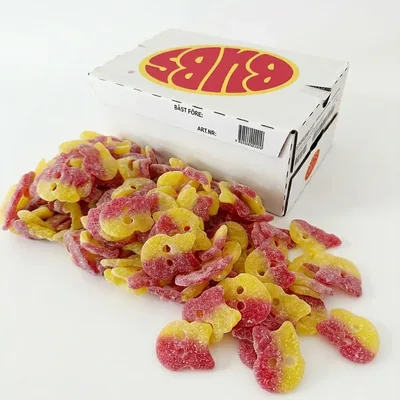
Sourness is the bigger gap. In Sweden, sour is a full category with a range of intensity rather than a single novelty flavor. Makers use higher acid loads and sour sugar coatings, and shoppers expect to choose their level. An 8.81 lb case of S-Märke Sour Apple is not the European answer to an American extreme-sour gimmick product, it is an everyday shelf item.
Flavors differ too. Melon, elderflower, cloudberry, blackcurrant, pear and salty licorice are ordinary in Europe and rare in the US. Blue raspberry, cotton candy and birthday cake run the other way. Our guides to Swedish candy flavors and Swedish sour candy types cover the range.
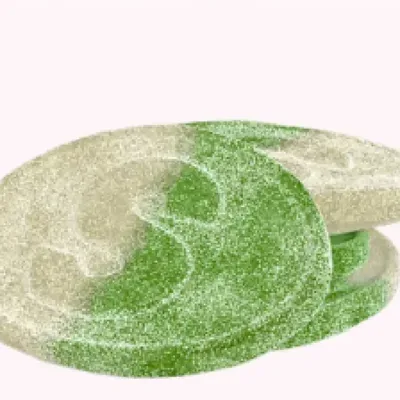
There is also a texture category the US mostly does not have: skum, the light aerated foam. It is not a marshmallow and it is not a gummy, and it is one of the fastest ways to make a candy wall feel genuinely imported. See Swedish foam candy and Swedish candy textures.
Format and portioning
This is the difference retailers feel first.
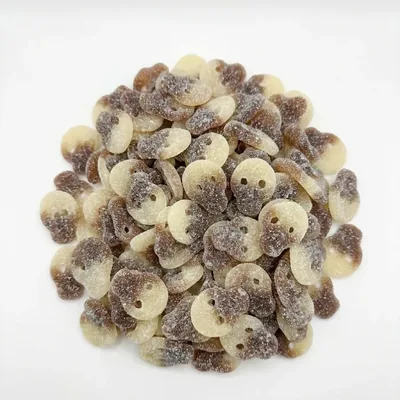
Most European candy is sold loose by weight from a wall of bins, so the shopper builds the bag. That model rewards variety of shape and texture, which is exactly why European makers produce fish, skulls, pacifiers, mushrooms, rockets, shots and slices instead of one hero product. American candy is dominated by the sealed unit: the bar, the peg bag, the theater box.
Labeling follows the same split. EU nutrition declarations are given per 100 g, US Nutrition Facts panels are given per serving with a defined serving size. Same product, two different reference points, which is why comparing sugar figures across the two without normalizing is meaningless. We covered that in sugar content in Swedish candy.
For a shop, the practical implication is that a European set works best as a weighed pick-and-mix wall rather than as pegged bags. Our pick and mix guide and how to run pick and mix cover the mechanics.
Price positioning
Imported candy costs more at the shelf, and it should. A case has crossed an ocean, cleared customs, paid duty, and been labeled for the US market before it reaches a bin. Production runs are smaller than the volumes behind a mass-market American bar.
The correct response is not to fight that on price but to merchandise into it. European candy is a specialty purchase with a story, a texture nobody else on the block has, and a pick-and-mix format that lets a customer decide their own spend. That is a margin-friendly position, not a difficult one. Run the numbers with our candy profit margins and how to price Swedish candy guides.
What this means for a US buyer
Do not buy European candy because you believe American candy is dangerous. That framing is wrong and your customers will eventually see through it. Buy it because it does things the domestic set does not: real sour range, foam texture, skull and pacifier shapes, loose-weight retail, and dietary flags that are unusually easy to communicate.
That last point is worth money at the counter. Every Matthijs case we carry is flagged gluten-free, halal, vegan and vegetarian. The BUBS lines are gelatin-free and vegan, several also halal. Where we do not hold a dietary flag on a case, we say so instead of guessing. See Swedish candy allergens and vegan Swedish candy.
Frequently asked questions
What is the main difference between European and American candy?+
Four things: which colorings and additives each regulator permits, how sweetness and sourness are balanced, how the candy is portioned (loose by weight in Europe, sealed units in the US), and price positioning. European candy also has a foam (skum) texture category the US largely lacks.
Is American candy less safe than European candy?+
No. Both the FDA and the EU regulate food additives and enforce limits. They maintain different permitted lists and use different mechanisms, and the EU has often used mandatory warning labels where the US uses a petition and approval route. Different is not the same as unsafe.
Why does European candy use natural colors?+
Largely because of one labeling rule. Six synthetic colors permitted in the EU must carry a warning that they may affect activity and attention in children, so many makers reformulated to plant-derived colorings such as fruit and vegetable concentrates rather than print that sentence on the pack.
Is European candy less sweet than American candy?+
Usually a little, and the sweetness reads differently. European gummies are commonly built on sugar and glucose syrup while American ones more often use corn syrup. The bigger gap is sourness: European makers treat sour as a full category with a real range of intensity.
Why is imported candy more expensive?+
Freight, customs duty, US labeling and smaller production runs all sit in the case price before it reaches your bin. The answer is to merchandise it as a specialty set with a story rather than to compete with a mass-market domestic bar on price.
Do you sell American candy?+
No. We import Swedish and European candy from Sweden, the Netherlands, Spain, Germany and Italy, and we ship it from our California warehouse. We do not carry chocolate, salmiak or salty licorice either.

Gustav Lindqvist · Candy Master
Gustav grew up in Sweden on a strict Saturday-candy schedule, mixing his lördagsgodis bag at the lösgodis wall before he could spell salmiak. He has spent years tasting his way across Scandinavian candy, and now curates the range at TheSweetsTruck, from BUBS sour skulls to the saltiest licorice most people cannot finish.
Last updated 8/23/2026