Seasonal Candy Planning: The Four Peaks, the Lead Times, and the Cash Flow
An operational year plan for candy buyers: the four peaks and how unequal they are, landed-date lead times, the cash-flow shape of a candy year, and dead-stock rules.

A candy year has four peaks of very unequal size: Halloween, Christmas, Valentine's and Easter, plus an event shoulder through summer. Plan each one backwards from a landed date rather than an order date, split every seasonal buy into a main order and a late top-up, and buy colour rather than seasonal packaging so nothing marks down. There is already a season-by-season version of this on the site, [the Swedish candy buying calendar](/journal/swedish-candy-buying-calendar), which covers what to order and when. This piece is the operational layer underneath it: how much, with what money, and how to end each season holding nothing you cannot sell.
The four peaks are not the same size
Treating the four as equivalent is the most expensive planning error in candy retail, because two of them are large and two are small, and the two small ones carry the most markdown risk.
Peak: Real selling window: Character: Markdown risk on branded stock
Halloween: About 3 weeks, concentrated in the final 10 days: Highest single-day volume of the year: Moderate
Christmas: About 7 weeks from November 1: Largest total revenue, two distinct halves: High
Valentine's: About 2 weeks: Smallest peak, highest margin per unit: Very high
Easter: About 3 weeks, moving date: Colour-led, basket-led: Very high
Halloween gives you a single enormous day. Christmas gives you the season. Valentine's is small but forgiving on price, because nobody negotiates on February 13. Easter is the awkward one because the date moves between March 22 and April 25 and has to be recalculated every year, which is why it gets its own piece in Easter candy for retailers.
The two big peaks sit back to back in Q4, which is covered in bulk candy for Halloween and Christmas and, for the December detail, Christmas candy for retailers. Valentine's has its own set in bulk Valentine's candy.
The season nobody plans
Between Easter and Halloween there is a five-month stretch with no holiday in it, and shops that plan only the four peaks treat it as dead time. It is not. It is event season.
Weddings, showers, graduations, birthdays, summer parties and corporate events run from April through August, and they buy in exactly the same way: colour-led, volume-led, decided a week or two ahead. Pastel cases that came in for Easter run straight into it. Sours track the school calendar and pick up again in late August.
Planning that shoulder deliberately does two things. It flattens your cash flow, and it gives your Easter leftovers somewhere to go. The event side is in wedding and event candy bars and bulk Swedish candy for cafes and events.
Lead times: plan to a landed date
The single most useful habit is to stop writing order dates in your calendar and start writing landed dates, then working back from them. The shelf does not care when you placed the order.
Peak: Place main order: Should be landed by: Top-up order placed
Halloween: Mid to late August: About 3 weeks before October 31: Around October 5 to 10
Christmas: Second half of October: Before Thanksgiving: December 5 to 8
Valentine's: Early January: Around January 25: Around February 2
Easter: 8 to 10 weeks before Easter Sunday: 3 weeks before: 10 to 12 days before
The top-up column is the one that earns its keep. By the time you place it you have real sell-through data instead of a forecast, and you can put money into the bins that are actually moving.
That only works because the transit is short and predictable. We ship from Santa Fe Springs, California, by UPS Ground or UPS Express. Canada ships DDP with duties paid at checkout, typically three to five days, so Canadian buyers should pull every top-up date forward by roughly half a week. Orders of $2,000 or more can move by pallet, arranged by email, which needs a longer conversation and should be raised a month or two ahead rather than in the top-up window.
Splitting the buy
A workable default for any seasonal buy:
About seventy percent as the main order. The stock you are confident about. Year-round anchors, proven colours, the cases you sold out of last year.
About twenty percent held for the top-up. Placed once the season has started and you can see which bins are draining.
About ten percent for one deliberate experiment. A format you have not tried, a brand you are curious about, one case only.
Those proportions are a starting point rather than a rule, and you should move them based on how well you know your own floor. The reason it is practical at all is that there is no order minimum, so you can order by the case, mix and match across brands, and come back for more without hitting a threshold. A buyer who has to clear a minimum on every order is forced to guess the whole season up front, which is exactly what produces dead stock.
The cash-flow shape of a candy year
This is the part that catches new shops, because the money moves before the revenue does, and it does it twice in a row.
August and September: outflow. Halloween stock is bought and paid for while summer trade is winding down.
October: the first big inflow, immediately followed by the Christmas outflow in the same month. October is the tightest month of the year for many candy retailers, because you are paying for Christmas out of Halloween money you have only just collected.
November: modest inflow, rising.
December: the biggest inflow of the year.
January: the hole. Trade collapses, you are sitting on whatever Q4 stock you misjudged, and Valentine's and Easter buying both want money in the first weeks of the month.
February: small inflow. Valentine's is high margin but small.
March or April: Easter inflow, whenever Easter falls.
May to August: the flattest stretch, which is precisely why the event shoulder is worth working.
Two practical consequences. First, protect January by not overbuying December, which is a stock discipline problem rather than a finance problem. Second, know your terms before you need them. With Earned Credit, an approved account's credit line equals its largest paid, delivered order (up to an account limit), spendable at checkout on NET-14 terms with a card covering any difference, so if you want a bigger line for your second Q4, build it with a larger paid, delivered order in the spring rather than asking in October.
Six rules for not holding dead stock
Buy colour, not occasions. A red bin is Christmas in December, Valentine's in February, and just a red bin in August. A printed snowflake bag is worth nothing on December 26. This is the single highest-leverage rule on the list.
Cap the seasonal-packaging share and write it down. Decide the fraction before you place the order, not after. Anything with a holiday printed on it has a hard expiry date and should be sized like a risk.
Keep the reorder trigger running through the peak. Most shops switch to eyeball judgement in December and stop noticing slow bins until the season is over. The trigger is more useful in a peak, not less. Set-up is in candy category management.
Bag it, do not discount it. A stalled case scooped into a mixed bag with two movers holds your price and lifts the basket. A markdown sticker trains customers to wait. The arithmetic is in candy profit margins.
Know where each seasonal case goes next. Before you buy it, name its second home. Pastel goes to spring events. Orange goes to autumn. Sours go anywhere. If you cannot name a second home, buy less of it.
Store it properly so patience is an option. Most of what we carry holds well past its season if it is sealed, cool and dry, which turns a leftover into a delay rather than a loss. Details in Swedish candy shelf life and candy shrinkage and waste.
The twenty-minute post-season review
Do this in the first week after every peak, while it is still fresh, and keep it in one document year over year.
Which three cases sold out, and how early. Which three cases you are still holding, and why you think that is. What you ran out of and could not replace in time. What the top-up order should have contained. Whether the landed date was right. And one sentence on what you will change next year.
Four of those documents and you have a buying calendar tuned to your own shop rather than to a general article, which is worth more than any advice we can give you.
Year-round anchors
Every seasonal plan needs a spine of cases that do not care what month it is. Tier 1 list prices below, current at the time of writing. The product page is always the authority.
Case: Case size: Tier 1 price: Why it anchors the year: Dietary flags we publish
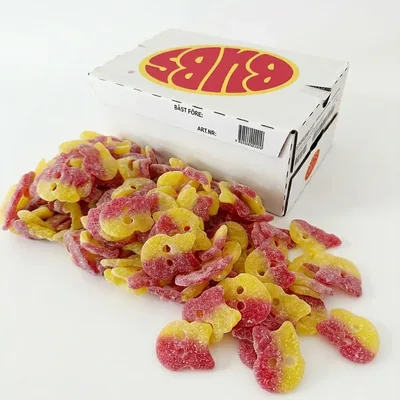
Bubs Lemon/Raspberry Skulls: 7 lb: $51.90: The reliable sour volume driver in every season: Gelatin-free, vegan
Matthijs Swedish Skulls: 4.41 lb: $28: The bin you can sign confidently for dietary shoppers: Gluten-free, halal, vegan, vegetarian
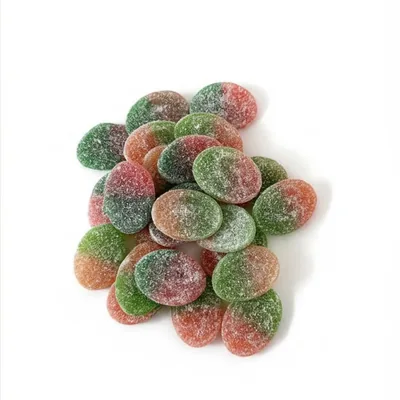
S-Märke Sour Strawberry: 8.81 lb: $59: Large case, red, works from Valentine's to Christmas: Halal, vegan
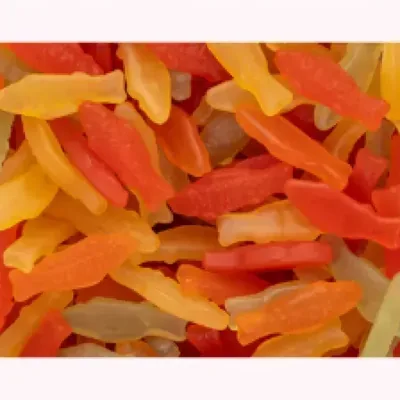
Pastel Fish: see product page: $45: Pastel spine for Easter, showers, weddings and summer: None on file
Read the last column exactly as written. The Matthijs line is flagged gluten-free, halal, vegan and vegetarian. Four S-Märke lines are flagged halal and vegan and do contain wheat, so they are not gluten-free items. Pastel Fish carries no flags in our data at all, so we publish none. If a customer needs the detail, ask us and we will send the documentation we hold.
Four cases that work in every season

Ordering
Order by the case, mix and match across brands, with no order minimum. That is what makes the main-order-plus-top-up method work, and it is the reason a small shop can plan a full year without committing the whole year's money in August.
We ship from Santa Fe Springs, California, by UPS Ground or UPS Express. Canada ships DDP with duties paid at checkout, typically three to five days. Orders of $2,000 or more can go by pallet, arranged by email. Tier 1 pricing is public, wholesale accounts approve automatically when you apply, and with Earned Credit an approved account's credit line equals its largest paid, delivered order (up to an account limit), spendable at checkout on NET-14 terms, with a card covering any difference.
Frequently asked questions
What are the four main candy seasons?+
Halloween, Christmas, Valentine's Day and Easter, plus a long event shoulder from April through August covering weddings, graduations and summer parties. Halloween gives the highest single-day volume, Christmas the largest total revenue, and Valentine's and Easter are small but high risk on seasonal packaging.
How far in advance should candy be ordered for a season?+
Plan to a landed date, not an order date. As a guide: Halloween landed three weeks before October 31, Christmas landed before Thanksgiving, Valentine's landed around January 25, and Easter landed three weeks before Easter Sunday. Hold budget back for a top-up once the season has started.
Which month is hardest for candy retail cash flow?+
Usually October and January. October because Christmas stock is paid for out of Halloween money you have only just collected, and January because trade collapses while Valentine's and Easter buying both want cash in the same weeks.
How do I avoid dead stock after a holiday?+
Buy loose candy chosen by colour rather than by holiday-printed packaging, cap the seasonal-packaging share of the buy deliberately, and name a second home for every seasonal case before you order it. If a case stalls, bag it with two movers rather than discounting it.
Should I buy the whole season in one order?+
No. Split it into roughly seventy percent as a main order, twenty percent held for a top-up placed once the season has started, and ten percent for one deliberate experiment. Because there is no order minimum, you can go back for the top-up without hitting a threshold.
How long does bulk candy keep between seasons?+
Most of what we carry holds well past its season when stored sealed, cool and dry, so an unsold case is usually a delay rather than a loss. See [Swedish candy shelf life](/journal/swedish-candy-shelf-life) for the storage detail and the exceptions.

Gustav Lindqvist · Candy Master
Gustav grew up in Sweden on a strict Saturday-candy schedule, mixing his lördagsgodis bag at the lösgodis wall before he could spell salmiak. He has spent years tasting his way across Scandinavian candy, and now curates the range at TheSweetsTruck, from BUBS sour skulls to the saltiest licorice most people cannot finish.
Last updated 9/25/2026