Swedish Fish vs Real Swedish Fiskar: What Is Actually Different
The American Swedish Fish brand and the fish-shaped candy Swedes actually buy are two different products. Texture, flavour, format, maker and price, compared.
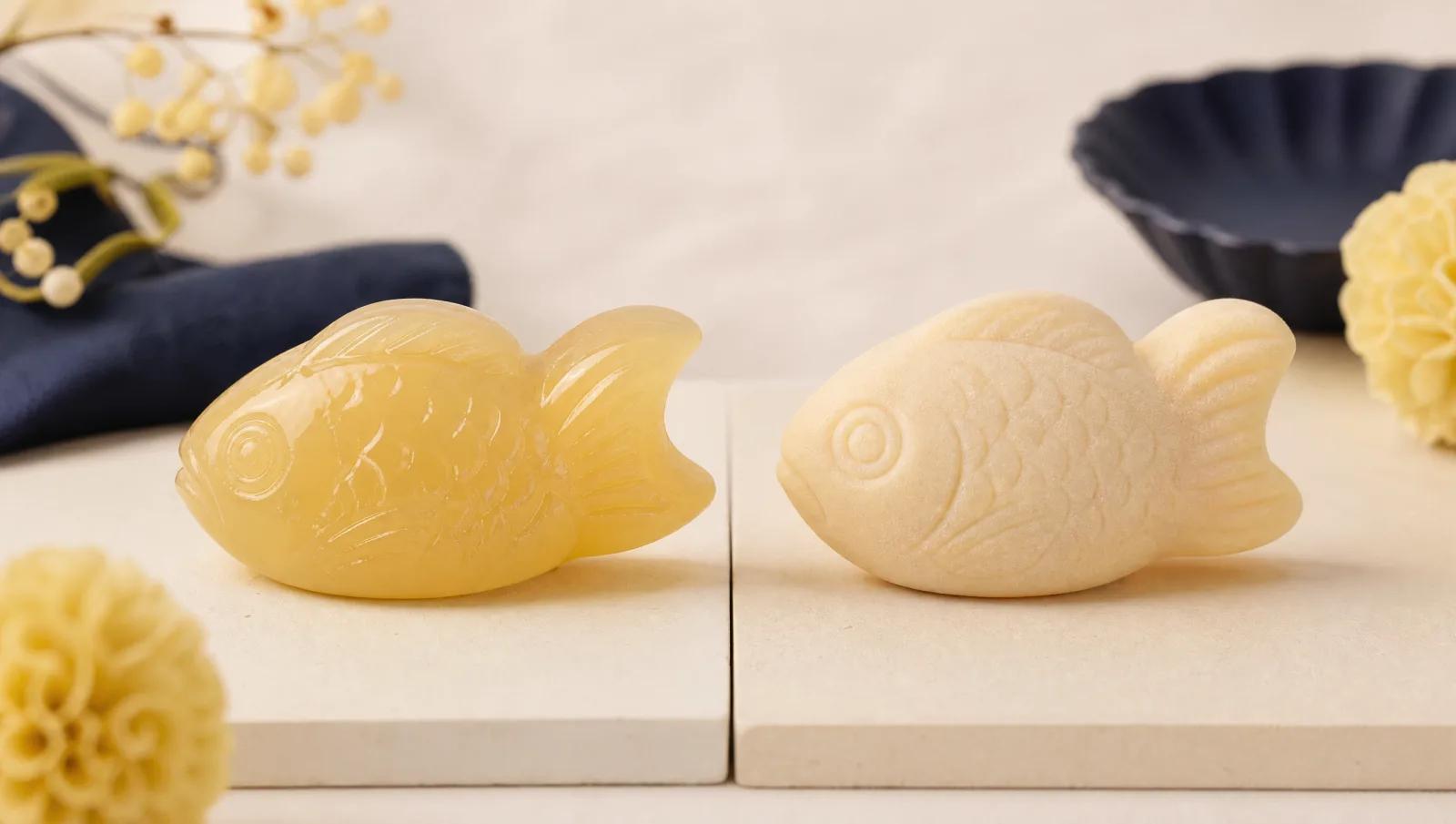
Swedish Fish is a North American candy brand owned by Mondelez International, sold pre-packed as one firm, dense red piece. Fiskar are the fish-shaped candies Swedes buy loose by weight, made by several different confectioners in soft pastel and sharp sour versions. Same silhouette, different product, different eating experience. We ran candy shops in Sweden before we started importing, so we have scooped a lot of fish into a lot of paper bags. Here is the honest side-by-side, without the marketing on either side.
Two products, one silhouette
Ask an American what Swedish Fish are and you get a very specific answer: a firm red fish, in a bag, from the checkout aisle. Ask a Swede the same question and you get a shrug, because in Sweden a fish is a shape, not a brand. Several confectioners make fish. They sit in the bins on the pick-and-mix wall next to the skulls, the cars and the foam, and nobody calls them "Swedish."
Whether the American brand has a real Swedish origin is a separate question, and the answer is more interesting than most people expect. We covered it in full in are Swedish fish actually Swedish, so we will not re-argue it here. This piece is about the two products as they exist on shelves today.
One thing to be clear about before we start. Swedish Fish is a registered trademark of Mondelez International. We do not sell it, we are not affiliated with it, and nothing in our catalogue is that product. What we import is genuine Swedish fish-shaped candy made for the Swedish loose-candy market. If you came here looking for the yellow bag, we are the wrong shop, and we would rather say so on the first screen.
The comparison, line by line
: Swedish Fish (US brand): Swedish fiskar (what we import)
Owner or maker: Mondelez International: Several Swedish and European confectioners
Main market: North America: Sweden and the Nordics
How it is sold: Pre-packed bag or box, sealed: Bulk case, scooped loose by weight
Customer pays by: The unit (a bag): The pound or the 100 g
Colour: Red dominant, with some multi-colour packs: Pastel assortments and bright sour colours
Texture: Firm, dense, slow chew: Softer and springier, plus foam and sour versions
Flavour: One consistent "red" flavour: Mild fruit (pastel) or sharp citric sour
Sour version: Exists as separate line extensions: A standard, expected bin on the wall
Piece size: Fairly uniform across the bag: Varies by maker and by bin
Dietary information: Read the pack: We publish only the flags our supplier data carries
Texture is the biggest gap
If you only notice one difference, notice this one. The American piece is dense. It resists, then gives, then stays with you for a while. That chew is the whole personality of the product, and people who love it love it precisely for that.
Swedish fiskar are generally softer and more elastic. A pastel fish yields almost immediately and dissolves rather than working. The sour versions are a little firmer than the pastels but still nowhere near the dense chew of the American piece. This is not a quality judgement in either direction, it is a matter of taste, and the two audiences genuinely do not overlap as much as you would think.
The practical consequence is worth knowing before you buy a case. A customer who reaches for Swedish fish-shaped candy expecting the American texture will notice within one piece. That is not a problem, it is a merchandising job, and the fix is a small sign. We go deeper on the whole texture question in Swedish candy textures.
Flavour: one note versus a spread
The American product runs a single flavour, described by almost everyone who tries to describe it as simply "red." It is consistent across the bag, which is part of the appeal, and the debate about what that flavour is supposed to be has its own long history. We wrote about that in what flavor are Swedish fish.
Swedish fiskar do not work that way, because loose candy does not work that way. A pastel assortment gives you several soft fruit notes across pale pink, yellow, green and orange pieces. A sour fish bin gives you a citric coating over a fruit base, which is a completely different sensation and a different customer. On a Swedish wall those are two separate bins, priced the same, chosen for mood.
Ingredients, and what we will not claim
The American brand's ingredient list is printed on the pack, and the pack is the right place to check it. We are not going to summarise a competitor's formulation from memory.
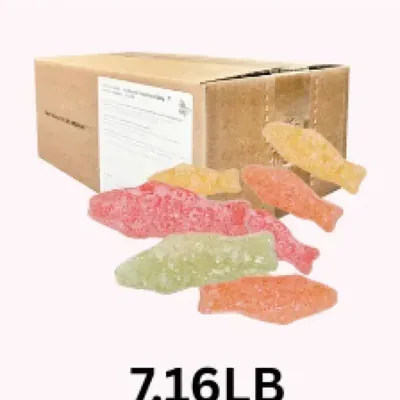
For our own cases we hold to one rule, and we hold to it even when it costs us a sale. Both of the fish cases we import, [Pastel Fish](/products/pastel-fish) and the [Sour Swedish Fish 7.16 lb case](/products/sour-swedish-fish-7-16-lb-swedish-candy), carry no dietary flags in our supplier data. So we publish none. Not gelatin-free, not vegan, not gluten-free, no claim at all.
That will look strange next to brands where we do publish flags, like the Matthijs skulls, which our data flags gluten-free, halal, vegan and vegetarian. The difference is the data, not the guess. A dietary flag is a promise, and the value of the flags we do publish depends entirely on us refusing to invent the ones we do not have. If you need to know before you eat it, read the case. If you are a retailer and you need our documentation, ask and we will send exactly what we hold.
Who makes each
The American brand sits inside a very large multinational, which is why it turns up in supermarket chains across the continent in identical form, and why it also turns up as a licensed flavour in other companies' products.
Swedish fiskar come from a fragmented industry of confectioners supplying the loose-candy trade. That is why there is no single canonical Swedish fish. It is also why the fish in one Swedish shop can be visibly different from the fish two streets away, and why Swedes do not think of the shape as belonging to anyone. Our fuller account of the everyday Swedish version is in real Swedish fish: what Swedes actually eat, and the pastel version specifically has its own guide in pastellfiskar.
Which one should you actually buy?
If you want the dense red chew you grew up with, buy the American brand from a US grocery store. We mean that.
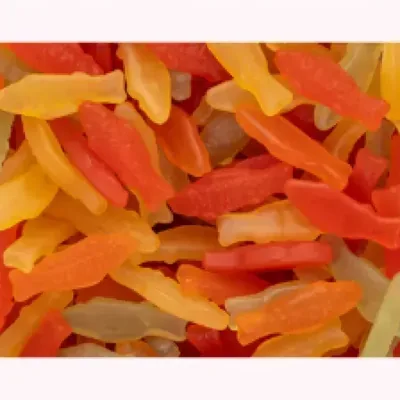
If you want to know what a Swedish person actually scoops into a bag on a Saturday, the pastel case is the closer answer, and the sour fish case is what the teenagers reach for. For a shop, the two together make a small, coherent fish section that gives customers a real choice rather than one bin and an apology.
Fish-shaped cases and the soft pieces that sit next to them

Frequently asked questions
Are Swedish Fish actually Swedish?+
The brand has genuine Swedish roots in its origin story, but the product sold in North America today is a Mondelez brand made for that market. Fish-shaped candy in Sweden is a separate, older, broader category sold loose. The full history is in [are Swedish fish actually Swedish](/journal/are-swedish-fish-actually-swedish).
What is the difference in taste?+
The American piece runs one consistent "red" flavour with a dense chew. Swedish fiskar are softer, and come as either mild pastel fruit or sharply sour. Most people notice the texture difference before the flavour difference.
Do you sell Swedish Fish?+
No. Swedish Fish is a Mondelez trademark and we are not affiliated with it. We import genuine Swedish fish-shaped candy in bulk cases, which is a different product.
Are your fish-shaped candies gelatin-free or vegan?+
Our supplier data carries no dietary flags for either fish case, so we publish no claim. Read the case, or ask us and we will send the documentation we actually hold.
Which fish case should a shop stock first?+
Start with one pastel case and one sour case. Pastel gives the wall visual relief and suits family and event customers, sour gives you the teenage sale. Bin mechanics are covered in [how to run pick and mix](/journal/how-to-run-pick-and-mix).
Is there a minimum order?+
No. You order by the case, mix and match across brands, with no order minimum.

Gustav Lindqvist · Candy Master
Gustav grew up in Sweden on a strict Saturday-candy schedule, mixing his lördagsgodis bag at the lösgodis wall before he could spell salmiak. He has spent years tasting his way across Scandinavian candy, and now curates the range at TheSweetsTruck, from BUBS sour skulls to the saltiest licorice most people cannot finish.
Last updated 8/23/2026